

Search for a face scrubber and the results mix scrub creams, silicone pads, buzzing brushes and metal spatulas, so it is hard to tell what you would actually be buying. Most of these are tools rather than skincare products, and they feel very different on your skin. This guide sorts out the four tool types, what each can and can't do, and who should skip them before you compare models.
What is a face scrubber, and how is it different from a scrub cream?
A face scrubber is a manual or powered tool that you use with your cleanser to clean your skin and gently exfoliate it through physical contact. A scrub cream is the opposite: a product with grains in it that you use up, while a face scrubber is hardware you rinse and reuse. If you would rather mix a gentle face scrub at home, our DIY guide covers which ingredients to use and which to skip.
Shops also call it a face wash scrubber, a scrubber for face wash, an exfoliating face scrubber or a face scrubber exfoliator. These names all describe the same kind of tool.
Two other products share the name and are not covered in depth here. An ultrasonic metal skin scrubber is a different device, and an "ice scrubber for face" is a separate kind of tool.
How does a face scrubber work?
A face scrubber works by moving a textured surface over wet skin while your cleanser lifts oil, dirt and makeup. The surface is either soft silicone touchpoints, which are small molded bumps, or a head of fine bristles. Sonic models add fast vibration, so the surface moves for you instead of relying only on your hand.
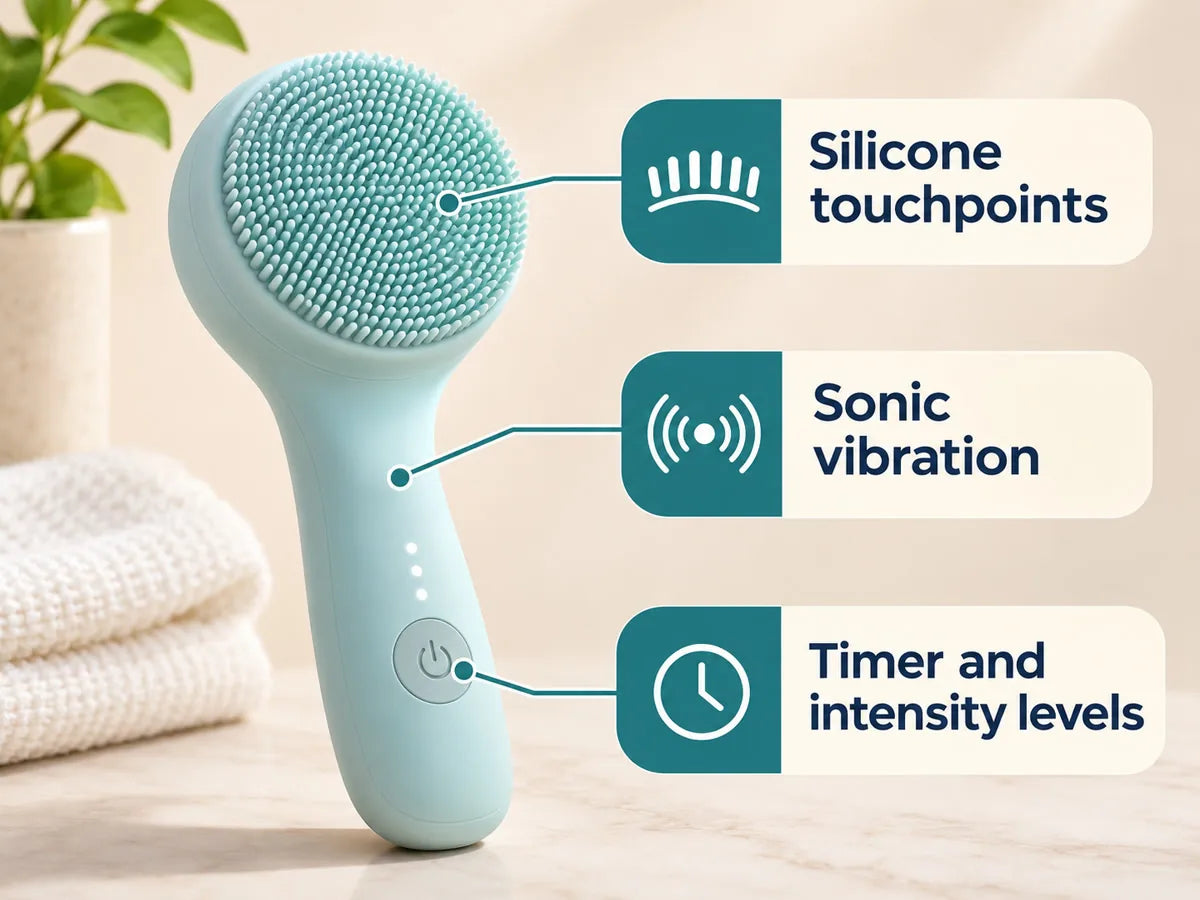
Contact surface, vibration, timer and intensity levels all vary by model. For example, one powered model lists 7,000 vibrations per minute, and another offers 16 intensity levels. These numbers describe a model's settings rather than proven skin results. Brands also measure vibration in different units, so don't compare models on these figures alone.
For a closer look at the motor side, see our guide on how sonic cleansing works.
Types of face scrubber: silicone pad, sonic brush, bristle brush and spatula
Face scrubbers differ in three ways that change how they feel: whether a motor does the work, what touches your skin and how gentle that contact is. The four types you will see are:
Manual silicone pad
A manual silicone pad is a small, flexible pad covered in soft nubs. You hold it in your fingers and move it in circles over your cleanser. It has no battery, so your hand supplies all the motion, and the silicone rinses clean under the tap.
- Best for: simple routines and anyone who wants a gentle face scrubber without charging.
- Pros: nothing to charge, easy to rinse, small enough to pack.
- Cons: you do all the work, and small pads can slip out of wet, soapy hands.
Sonic silicone brush
A sonic silicone brush pairs soft silicone touchpoints with sonic vibration, so the pad works your cleanser over your skin while you glide it. Silicone has no replaceable head and dries fast.
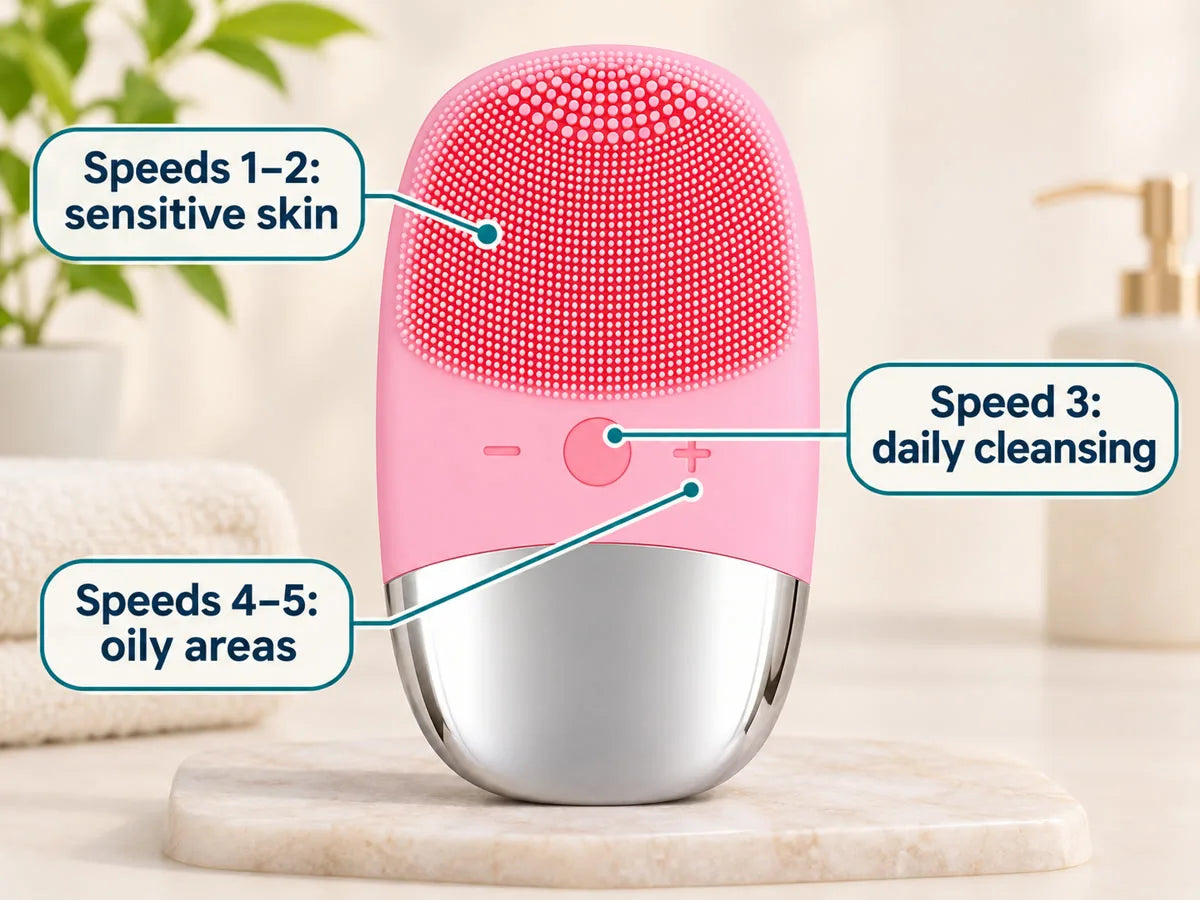
Two examples show how features differ:
- The Waterproof Silicone Sonic Facial Cleansing Brush has five speeds, a built-in timer and USB charging. The maker suggests speeds 1–2 for sensitive skin, 3 for daily cleansing and 4–5 for oily areas.
- The Sonic Facial Cleansing Brush with Warm Massage Side has six intensity levels, a warm back side and magnetic USB charging.
Both are rated IPX7 waterproof, which means they survive temporary immersion up to 1 m (about 3.3 ft) for 30 minutes, so you can use them in the shower.
- Best for: daily cleansing and shower routines.
- Pros: soft contact, adjustable settings, no heads to buy.
- Cons: needs charging, and gives a gentler, less "scrubby" feel.
Rotating bristle brush
A rotating bristle brush has a round head of fine nylon bristles that a motor spins or swings back and forth. Spinning bristles are more abrasive than silicone, so the brush feels firmer, and some owners find it too rough and silicone easier to keep clean. For a full comparison, see our silicone vs bristle guide.
- Best for: oily, sturdy skin that likes a firmer feel.
- Pros: strong scrub feel, often the cheapest powered option.
- Cons: replacement heads cost extra, and one maker advises swapping nylon heads about every 3 months.
Ultrasonic spatula (a different tool)
An ultrasonic skin scrubber is a flat metal blade that vibrates above 20 kHz, the ultrasound range, and you glide it over wet skin to lift surface residue. It is not a cleansing brush. It needs a careful angle and constant motion, and it carries different results and risks, so this guide doesn't cover it further.
Note: Read the manufacturer's instructions before using one, because manuals list strict limits, and one forbids use with a pacemaker or other implanted electronics.
What can a face scrubber do for your skin?
The effects of a face scrubber are cosmetic, and the evidence behind them is limited, because the few studies were small and tested particular devices. The main benefits are:
A cleaner-feeling face after washing
A face scrubber can add mechanical action to washing by hand, and some owners say their face "feels cleaner" afterward. Whether it cleans better than your hands is less certain. The studies had 12 to 46 participants each and tested one device and routine at a time, so they can't show that the whole category beats gentle cleansing with your fingertips.
Smoother-looking skin from an exfoliating face scrubber
Mechanical exfoliation means removing dead skin cells with a tool. Using a face scrubber this way clears dead cells from the skin's outer layer, which can make your skin look and feel smoother.
Keep the contact light: brushes work best resting flat on the skin, and pressing harder makes them less effective. How often you use it depends on your skin. One maker says daily use is fine, while the American Academy of Dermatology (AAD) advises exfoliating less often with firmer tools and cutting back if your skin turns red.
A steadier routine with a timer
A built-in timer keeps each area of your face short and even, so you don't over-scrub one spot. Timers vary by model. The Waterproof Silicone Sonic Facial Cleansing Brush has a built-in timer, and its maker suggests about 20 seconds per area. Another maker's manual advises no more than 3 minutes per use, even though its app timer can be set longer.
What a face scrubber can't do
A face scrubber can't fix acne, shrink pores or reliably beat a gentle cleanser and your hands. Keep these limits in mind:
- Acne: One 4-week study of 46 people saw improvement with a sonic brush, but it had no control group, and the participants also used a cleanser and their usual skin care, so it can't show the brush caused the change. Scrubbing can make inflamed acne worse.
- Pores: Pores can look less noticeable after cleansing, but no tool can shrink them.
- Handwashing: No independent study shows that a home device cleans better than fingertips for everyone.
- Brand promises: "Deep pore" cleansing, lifting, firming and better product absorption are product claims, not proven results.
- Real-world results: Some owners notice little difference, or still reach for a washcloth.
Who is a face scrubber for?
Whether a face scrubber fits you depends on your skin type and how much friction it tolerates. The two groups are:
Good fit
A face scrubber suits you best if you have:
- Oily or combination skin: thicker skin may handle mechanical exfoliation better.
- A shower routine: an IPX7 waterproof brush can go in the shower.
- A wish for structure: a timer gives you a steady, repeatable routine.
These match the listed uses for the Waterproof Silicone Sonic Facial Cleansing Brush: daily cleansing, oily and combination skin, and shower use. If you shave or have stubble, our guide to the facial scrubber for men covers how to fit one into a shaving routine.
Take care or avoid
Some skin needs a gentler approach than an exfoliating scrub brush:
- Dry, sensitive or acne-prone skin: mechanical exfoliation can be too irritating, so a washcloth or your fingertips may suit you better. Our face scrubber for sensitive skin guide covers this in detail.
- Rosacea: the AAD advises washing with fingertips only.
- Retinoids, retinol or benzoyl peroxide: exfoliating on top of these can worsen dryness or irritation.
- Darker skin or dark spots: aggressive exfoliation can deepen discoloration in some people.
- Sunburn, cuts, broken or irritated skin: skip the tool on these areas.
- A diagnosed skin condition: ask a dermatologist before you start.
Face scrubber safety: heat, charging, hygiene and when to stop
Face scrubber safety comes down to a few habits: keep heat comfortable, charge only when the device is dry, clean the tool after each use and stop at the first sign of irritation.
- Heat: The warm side of the Sonic Facial Cleansing Brush with Warm Massage Side reaches about 108–113°F (42–45°C). Stop if it feels too hot.
- Charging: Dry the device fully before charging, and don't use it while it charges. A USB port must be dry before you plug in, while a magnetic charger leaves no open port to keep dry.
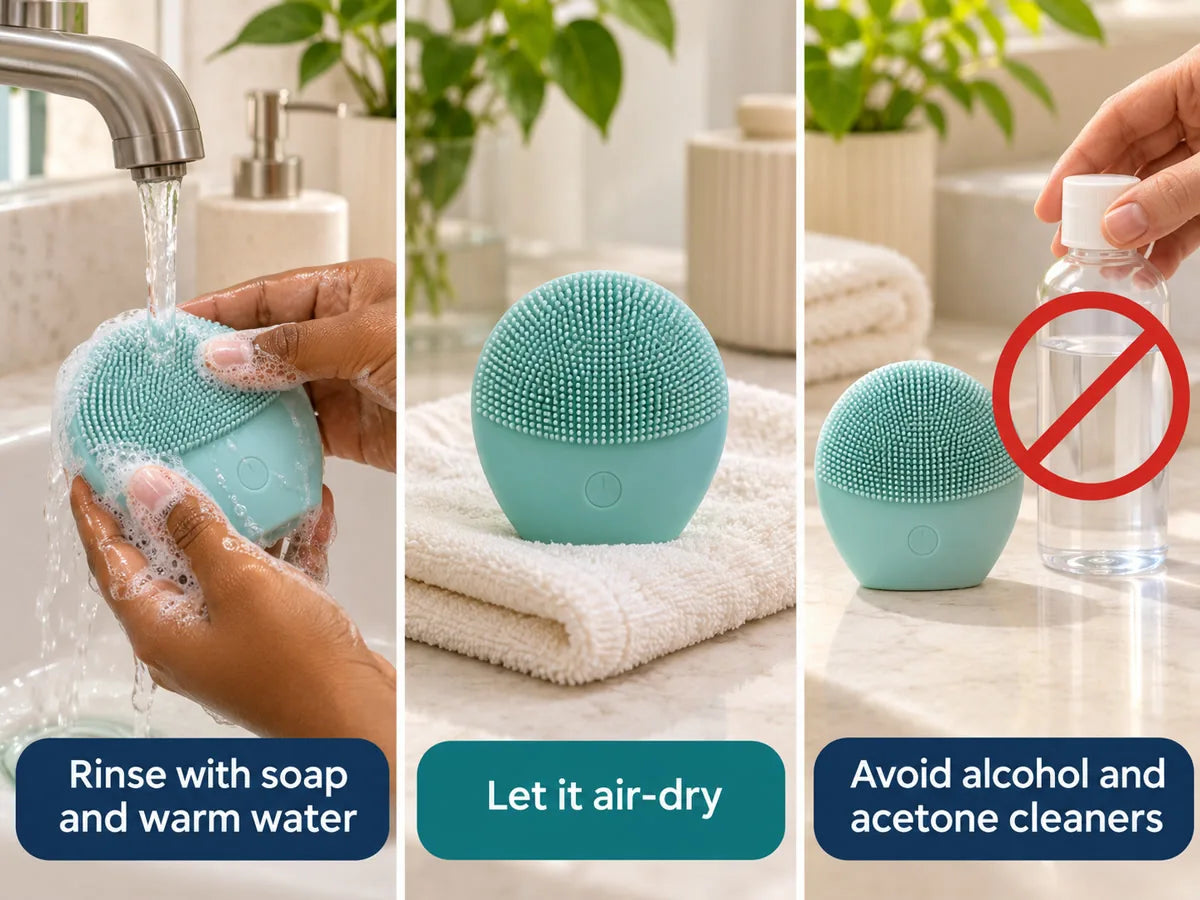
- Hygiene: Rinse silicone with soap and warm water after each use and let it air-dry. Avoid alcohol, petrol or acetone cleaners, because they can damage silicone. Don't share the tool with others.
- Cleansers: Skip gritty or grainy cleansers with a brush.
- Eyes and children: Keep the device away from your eyes and eyelids, and out of reach of children.
Note: Stop if you feel pain or notice redness, rash or itching, and see a dermatologist if it doesn't settle.
Where to go next: how to use a face scrubber and pick the best one
Start gently: use the lowest setting and light pressure, then increase only if your skin stays comfortable. When you are ready for the next step, these guides cover it in detail:
- How to use a face scrubber: steps, how often to use it and how to clean it.
- Best face scrubber: the buying criteria that matter, and the marketing claims you can ignore.
You'll find both in our Beauty Device Guides blog.
[dyl-products: silicone-sonic-facial-cleansing-brush, sonic-facial-cleansing-brush-warm-massage]
Frequently asked questions
How can you tell if you're over-exfoliating?
Redness, irritation or dryness after using your face scrubber are common signs of over-exfoliating. Stop until your skin calms down, then return on a lower setting and use the tool less often. If the irritation doesn't go away, see a dermatologist.
Can you use a face scrubber in the shower, and how does it charge?
You can use a face scrubber in the shower if it is rated IPX7, and both brushes named above are. The Waterproof Silicone Sonic Facial Cleansing Brush charges by USB (5V/1A), so keep its port dry. The Sonic Facial Cleansing Brush with Warm Massage Side uses a magnetic USB cable. Neither comes with a wall plug.
Do you need to replace a face scrubber head?
Whether you need to replace a face scrubber head depends on the model. One manufacturer says its silicone head never needs replacing, while nylon bristle heads wear out over time. Check your manual, rinse and dry the head after every use, and replace any part that cracks or tears.
A face scrubber works best when its type matches your skin's tolerance: a gentle silicone tool for most people, firmer bristles only for oily, sturdy skin, and light pressure from the very first use. Think of it as a cleansing helper, not a fix for skin concerns. Compare options in our facial cleansing devices collection. Every Decor Your Life order ships free in the US, with 30-day returns on unused items and a 12-month limited warranty.