

You want a face tool that feels nice and stays clean, but you worry that a silicone face scrubber or a bristle brush could leave your skin red or set off breakouts. Silicone is often sold as the gentler, cleaner choice, and that claim is worth checking before you buy. Below, you can compare the two on care, feel, durability and skin fit, then match one to your routine.
Silicone face scrubber vs bristle brush: which is better for your skin?
Choose a silicone face scrubber if you want a tool that rinses clean, dries fast and has no brush heads to replace. Choose a bristle brush if you like a firmer scrub and your skin handles it well.
Material alone does not decide which one is gentler. Touchpoint softness, bristle stiffness, pressure and your skin type all play a part. Fingertips and a gentle cleanser are enough for routine face washing, so either tool is an extra, not a must. If you do add a brush, our guide on how to use a face scrubber covers settings, timing and cleaning.
Choose a silicone face scrubber if…
- Easy care: you want a tool that rinses clean and dries fast.
- No spare heads: you would rather not buy and keep track of replacement heads.
- Shower routine: you cleanse in the shower and choose a powered model rated IPX7.
- Softer feel: you like cushioned contact and are happy to start on the lowest setting.
Choose a bristle brush if…
- Firmer feel: you enjoy a familiar, scrubby clean.
- Resilient skin: your skin is oily or normal and handles exfoliation without turning red.
- Head upkeep: you don't mind replacing heads and washing them every week.
- Skip it if: you have rosacea, or dry or sensitive skin.
What is a silicone face scrubber and what is a bristle brush?
A silicone face scrubber and a bristle brush are both handheld tools that touch your skin to help a cleanser clean your face. Each comes in manual and powered versions. Here is how they are built:
Silicone face scrubber
A silicone face scrubber, also sold as a silicone face brush or silicone facial cleansing brush, is a cleansing tool with soft, molded silicone bumps, called touchpoints, in place of nylon bristles. Powered models add sonic vibration, a fast buzz that moves your cleanser over wet skin, and most let you choose a lower or higher intensity. The action is purely mechanical, so the tool helps you cleanse but does not change the skin itself.
- Best for: people who want soft contact and little upkeep.
- Pros: washable surface, no replaceable head on many models, adjustable intensity on powered versions.
- Cons: less of a "scrub" feel, and vibration specs are hard to compare.
Makers measure vibration in different ways. One model lists 100 Hz and another lists 7,000 vibrations per minute, so these numbers are not a fair way to compare brushes.
Bristle face brush
A bristle face brush is a cleansing tool with a head of fine filaments, usually nylon, grouped in tufts. A manual brush is a handle and head. On powered brushes, the bristles either vibrate at sonic speed or spin in a circle. Stiffness varies from head to head, and most heads are made to be swapped out.
- Best for: normal to oily skin that is not sensitive.
- Pros: a firmer, familiar scrubbing feel, with different heads available for some models.
- Cons: heads wear out and cost extra, and the tufts need regular cleaning.
Silicone face scrubber vs bristle brush: key differences
Silicone and bristle tools both clean through light physical contact, so the real differences show up in daily care and in how each one feels on your face. The key differences include:
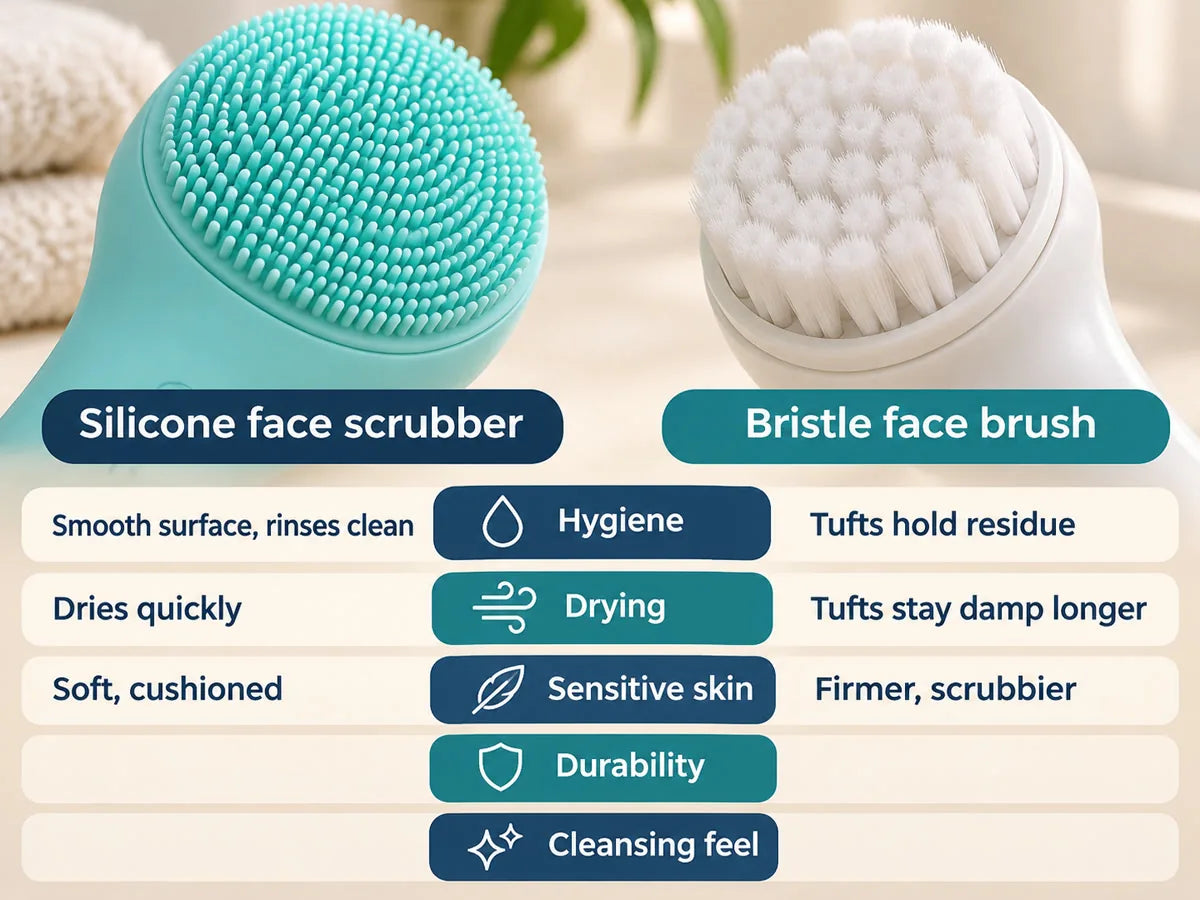
| Factor | Silicone face scrubber | Bristle face brush |
|---|---|---|
| Hygiene | Smooth surface rinses clean, still needs washing | Tufts hold residue, need regular washing |
| Drying | Dries quickly | Tufts can stay damp longer |
| Sensitive skin | Soft feel, not gentler for everyone | Depends on stiffness, can feel harsh |
| Durability | Head usually not replaced | Heads wear out and need replacing |
| Cleansing feel | Soft, cushioned | Firmer, scrubbier |
Hygiene and drying time
Silicone rinses clean and dries quickly because water and leftover cleanser have little to cling to on its smooth surface. That does not make it self-cleaning or antibacterial. Residue still builds up if you skip rinsing, so wash the touchpoints with soap and warm water after every use.
Bristle tufts can stay damp longer, so they need more care. One bristle-brush maker advises washing the head and handle once a week with warm soapy water.
Gentleness on sensitive skin
There is no evidence that silicone is gentler for everyone, and skin reacts differently to both materials. Touchpoint softness and bristle stiffness vary by model, so two silicone tools can feel quite different on the same face. A low intensity setting lets you control how hard the tool works against your skin.
Note: Any scrubbing tool can irritate dry or sensitive skin, because brushes, pads and sponges are a form of mechanical exfoliation, which rubs dead skin cells off by friction.
Durability and head replacement
Silicone heads are usually not swapped. One maker states that its silicone brush head does not need replacing, but that is a claim about one product, not a rule for every model. Bristles wear down with use, and one bristle-brush maker advises a new head about every 3 months. Check the manual and the price of replacement heads before you buy.
On powered models, also check how the tool charges and whether it has a real water rating. IPX7, for example, means the device survives brief immersion up to 1 m (about 3.3 ft) for 30 minutes. A "waterproof" label without a code tells you much less.
Cleansing feel and exfoliation
Silicone touchpoints feel soft and cushioned, while bristles feel firmer and more like a scrub. Both tools move cleanser over the skin to lift surface dirt, oil and dead cells. Neither one reaches deep into pores or shrinks them. If you have stubble or a beard, our men's face scrubber guide looks at how each tool fits a shaving routine.
Use short, light strokes. Pressing harder does not get skin any cleaner, and a brush works best when it sits flat against the skin without force.
Is a silicone face scrubber safe for sensitive or acne-prone skin?
Not always: dry, sensitive or acne-prone skin may find any scrubbing tool too irritating, silicone included, so if you try one, use light contact on a low setting. How your skin responds depends on your skin type, the active products you use and how hard you press. Take extra care in these cases:
- Dry, sensitive or acne-prone skin: mechanical exfoliation can be too irritating, so a washcloth or simple fingertip cleansing may suit you better.
- Rosacea: dermatology guidance says to wash with fingertips only and avoid scrubbing, so skip the tool.
- Inflamed acne: scrubbing can make breakouts look and feel worse.
- Retinoids, retinol or benzoyl peroxide: extra exfoliation on top of these can add dryness or irritation, or trigger breakouts.
- Cuts, wounds or sunburn: never use the tool on broken or burned skin.
- Darker skin tones or dark spots: aggressive exfoliation can darken pigmentation in some people.
A face scrubber is not an acne treatment. The studies on cleansing brushes are small and often company-linked, and none tested silicone scrubbers on their own.
Note: Stop if your skin turns red or stings, and see a dermatologist if the irritation lasts or your acne keeps flaring. Check with your doctor first if you are under care for a skin condition or have had a recent cosmetic procedure.
Which silicone face scrubber from Decor Your Life fits you?
Decor Your Life carries two powered silicone options. Both are rated IPX7 and charge by USB, so your choice comes down to the extras you want. Here is how they differ:
Waterproof Silicone Sonic Facial Cleansing Brush
The Waterproof Silicone Sonic Facial Cleansing Brush is a compact sonic brush built for a simple daily cleanse, especially on oily or combination skin and in the shower. Its soft silicone touchpoints come in three zones of different density for the forehead, nose area and cheeks. A built-in timer helps you spend an even, short time on each area.
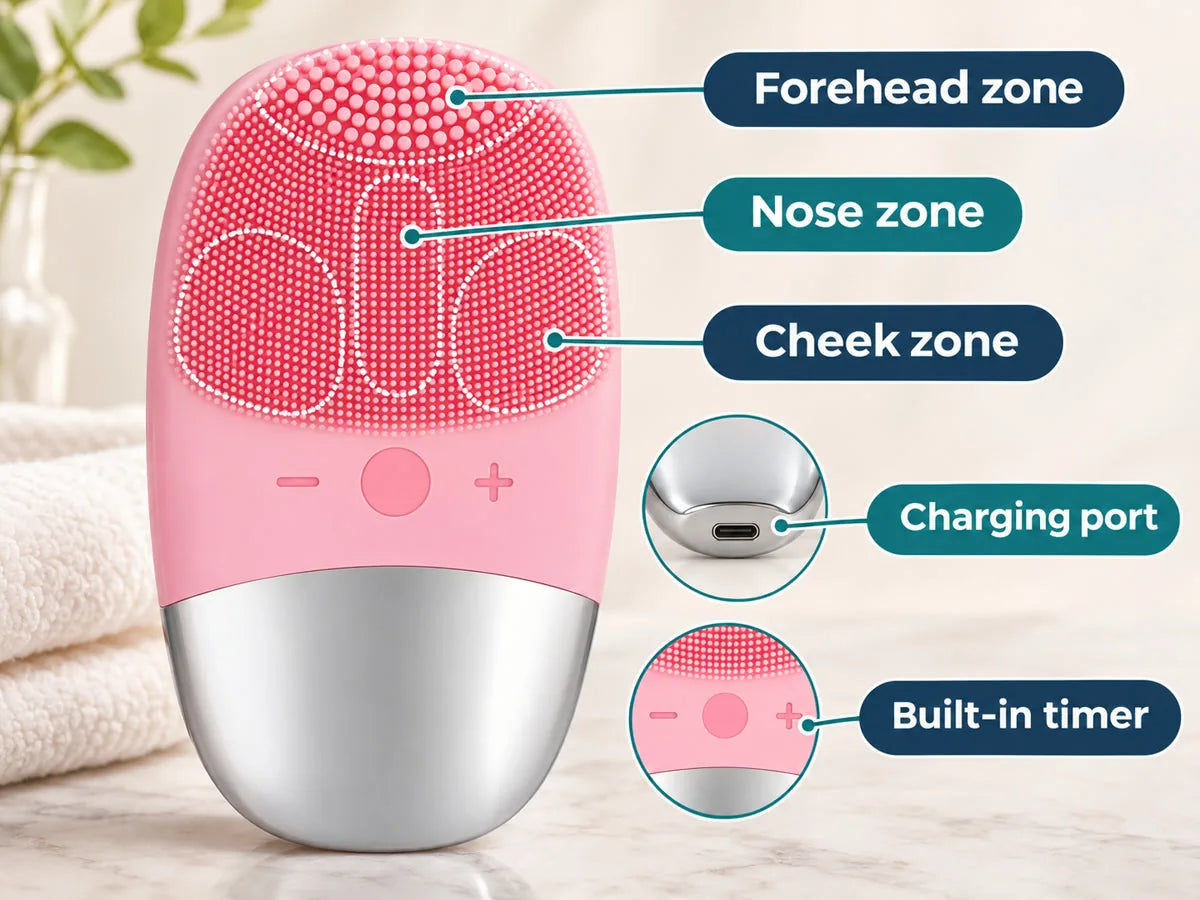
- Speeds: five, with 1–2 for sensitive skin, 3 for daily cleansing and 4–5 for oily areas.
- Charging: USB (5V/1A) through a charging port.
- Size: about 4.1 x 2.6 x 1 in (10.5 x 6.5 x 2.5 cm).
- Warranty: 12-month limited warranty.
Note: Make sure the charging port is dry before you plug it in, and do not use the brush on broken or irritated skin.
Sonic Facial Cleansing Brush with Warm Massage Side
The Sonic Facial Cleansing Brush with Warm Massage Side cleans on the front and warms on the back, so it suits you if you also want a relaxing massage after serum or lotion. Its four zones are a dense area for daily use, a firmer area for oily spots, a small tip for around the nose and the warm massage side.
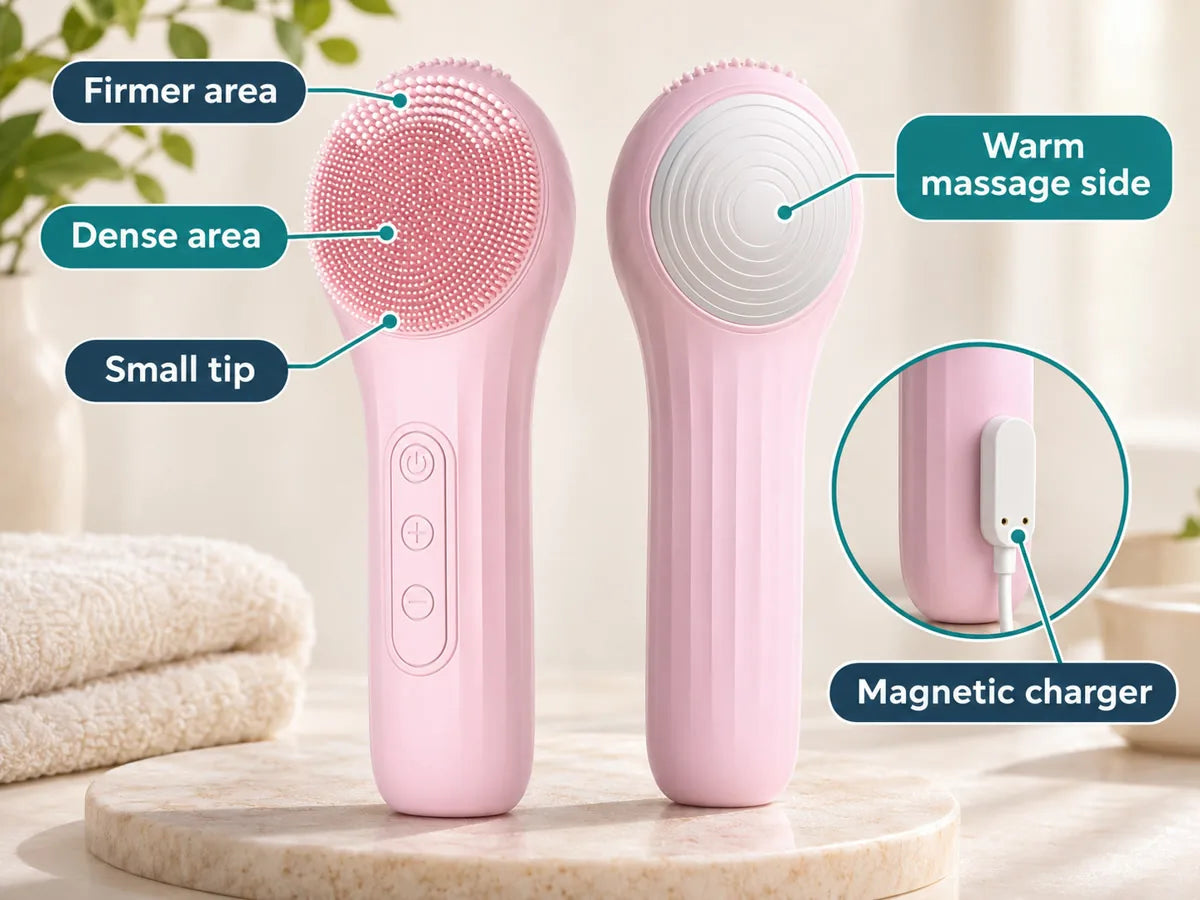
- Intensity: six levels, so you can start low and raise the level only if it feels comfortable.
- Warm side: about 108–113°F (42–45°C) for a gentle, warm finish.
- Charging: a magnetic USB charger clicks on, so there is no open port to keep dry.
- Warranty: 12-month limited warranty.
Note: Stop if the warm side feels too hot, and skip broken or irritated skin.
How to use and clean a silicone face scrubber
Use a silicone face scrubber on wet skin with light contact for about a minute, then wash the tool and let it air-dry.
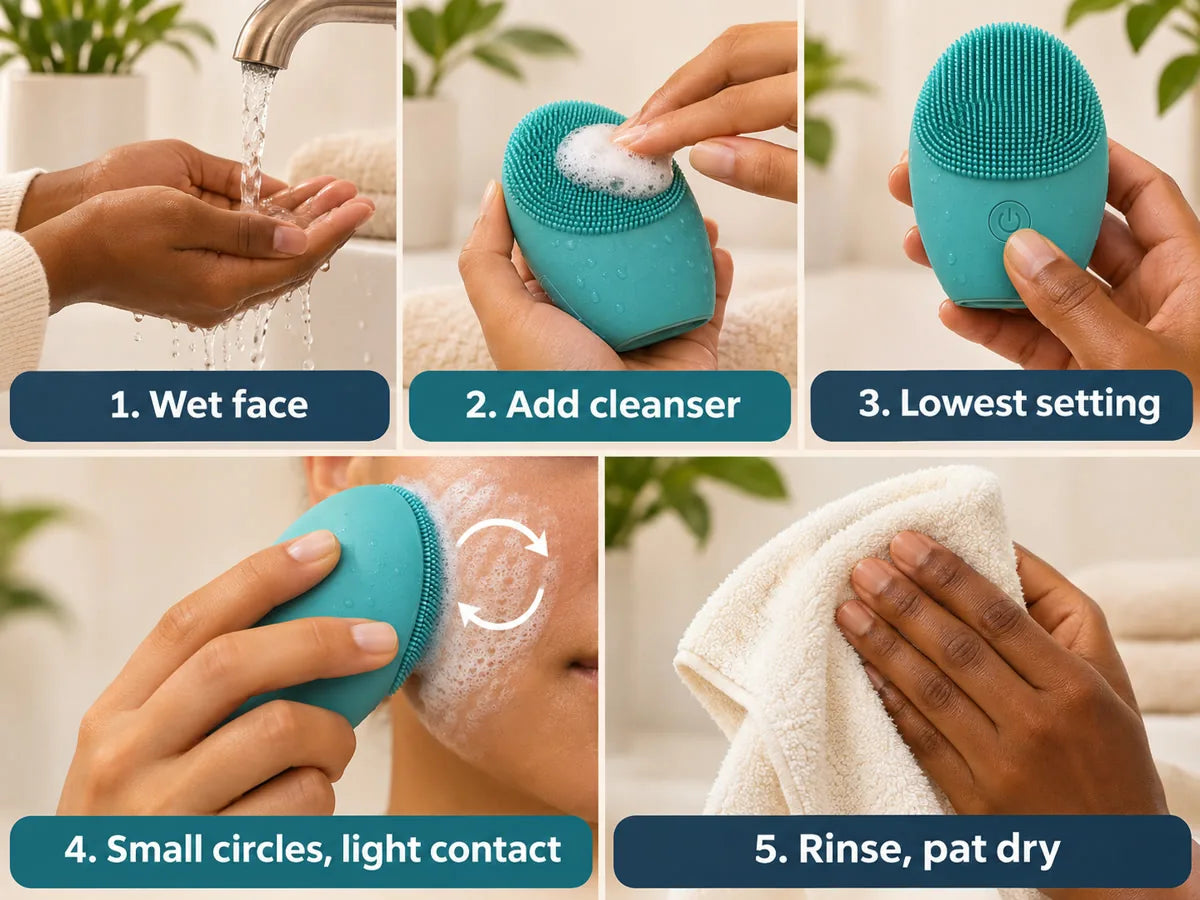
- Remove your makeup and wet your face with lukewarm water, not hot water.
- Wet the scrubber and apply a gentle cleanser to your face.
- Switch a powered model on at its lowest setting.
- Glide the scrubber in small circles with light contact, avoiding your eyes and eyelids, for about 20 seconds per area or as your manual directs.
- Rinse with lukewarm water, pat dry and apply moisturizer.
Note: Keep the whole routine short. One-minute routines are common, and one maker advises no more than 3 minutes per session.
Then look after the tool:
- After every use: wash the silicone with soap and warm water, rinse it and let it air-dry.
- Cleaners to avoid: alcohol, petrol, acetone and abrasive or grainy products, because they can damage silicone.
- Powered models: follow the manual on water exposure, dry the tool fully before charging and never use it while it is charging.
- Manual scrubbers: wash them the same way, without the charging steps.
- Storage: keep the tool dry and out of direct sun and heat, and don't share it.
[dyl-products: silicone-sonic-facial-cleansing-brush, sonic-facial-cleansing-brush-warm-massage]
Frequently asked questions
Can I use a silicone face scrubber every day?
Yes, once a day is enough for most skin, which is also the guidance for both Decor Your Life brushes. Keep the contact light and the setting low, and cut back or stop if your skin turns red. A tool is optional, since fingertips and a gentle cleanser are enough for daily washing.
Does a silicone face scrubber remove blackheads?
No, there is no proof that a silicone face scrubber removes blackheads, although it can help lift surface dirt and oil. A blackhead is a clogged pore that stays open, and its dark color is not dirt, so pressing harder will not clear it.
What cleanser should I use with a silicone face scrubber?
A gentle cleanser works best, the same kind dermatologists suggest for everyday washing. Skip grainy scrubs, clay and silicone-based cleansers, because one maker warns they can damage silicone touchpoints and they add friction on your skin. Rinse your face and the tool well afterward.
Can I use a silicone face scrubber with retinol or AHAs?
Only with caution: exfoliating on top of retinol or exfoliating acids such as AHAs can add dryness and irritation. Use the lowest setting on days you skip those products, or leave the tool out. Ask a dermatologist if you are unsure.
Can I return a Decor Your Life facial brush if it doesn't suit my skin?
You can return a facial brush as long as it is unused. We offer 30-day returns on unused items, and for change-of-mind returns the customer pays return shipping. Damaged, defective or wrong items are replaced or refunded with no need to send them back. See our returns and refunds policy.
A silicone face scrubber is the easier tool to keep clean because it rinses fast, dries quickly and usually needs no new heads. Your skin's tolerance still decides which tool fits you. Start gentle, keep the contact light and stop if you see redness. Compare options in our facial cleansing devices collection, with free US shipping on every order.