

You just unboxed a silicone brush and want to know how to use face scrubber tools without leaving your skin red, tight or overworked. The worry makes sense. A brush adds friction to your routine, and too much pressure, speed or frequency shows up fast on dry or sensitive skin. Below you'll find the technique, a starting frequency by skin type and an easy cleaning routine.
How to use face scrubber step by step
To use a face scrubber, wet your face and the brush, add a mild cleanser and switch on at a low speed. Then glide it in small, light circles for about a minute, keeping it off the eye area. Finish by rinsing your face, patting it dry, rinsing the brush and letting it air-dry.

Let the brush do the work with light contact, and stop if your skin stings, burns or turns red. These steps are for silicone and sonic cleansing brushes. If your device's manual says something different, follow the manual.
The order of these steps matters. Clean, wet skin and a mild cleanser let the brush glide instead of drag, and a low start shows you how your skin reacts. The six steps are:
Step 1: Remove makeup and wet your face and brush
Take off your makeup first, so the brush cleans your skin instead of pushing foundation around. Then wet your face and the brush head with lukewarm water. Water helps the cleanser spread and lets the silicone glide, so you get less friction on your skin.
Step 2: Apply a gentle cleanser
Apply a small amount of your usual mild cleanser to your face or the brush. Don't use a gritty scrub or a strong exfoliating cleanser here. The brush already adds mechanical exfoliation, and stacking two scrubbing steps doubles the friction on your skin.
Step 3: Turn on the brush at a low speed
Switch on at the lowest setting and raise it only if your skin feels comfortable. On the Waterproof Silicone Sonic Facial Cleansing Brush, speeds 1–2 suit sensitive skin. On the warm-side brush, start at the lowest of its six levels. The Waterproof Silicone Sonic Facial Cleansing Brush also has a built-in timer that helps you keep each area short and even.
Step 4: Move in small circles, away from your eyes
Glide the brush in small circles with light contact, keeping it flat against your skin. Pressing harder doesn't clean better and only adds friction, so let the brush glide. Spend about 20 seconds per area on your forehead, the nose area and your cheeks, for about one minute in total.

The silicone sonic brush has three zones with different densities for these areas. The warm-side brush has a small tip for around the nose.
Note: Keep the brush away from your eyes and eyelids, and stop right away if your skin stings.
Step 5: Rinse your face and pat dry
Rinse off all the cleanser with lukewarm water, because leftover cleanser can leave skin feeling tight. Pat your face dry with a soft towel instead of rubbing it. Apply your usual moisturizer right after.
Step 6: Rinse the brush and let it air-dry
Rinse the brush head under the tap after every use to wash off cleanser and residue. Then let it air-dry, which silicone does quickly. On the Waterproof Silicone Sonic Facial Cleansing Brush, check that the charging port stays dry. The warm-side model charges magnetically, so it has no open port, and it stands upright to dry.
What is a face scrubber, and which type are you using?
A face scrubber is a catch-all name for tools and products that physically scrub the skin while you cleanse. Each type has its own instructions, so check which one you have:
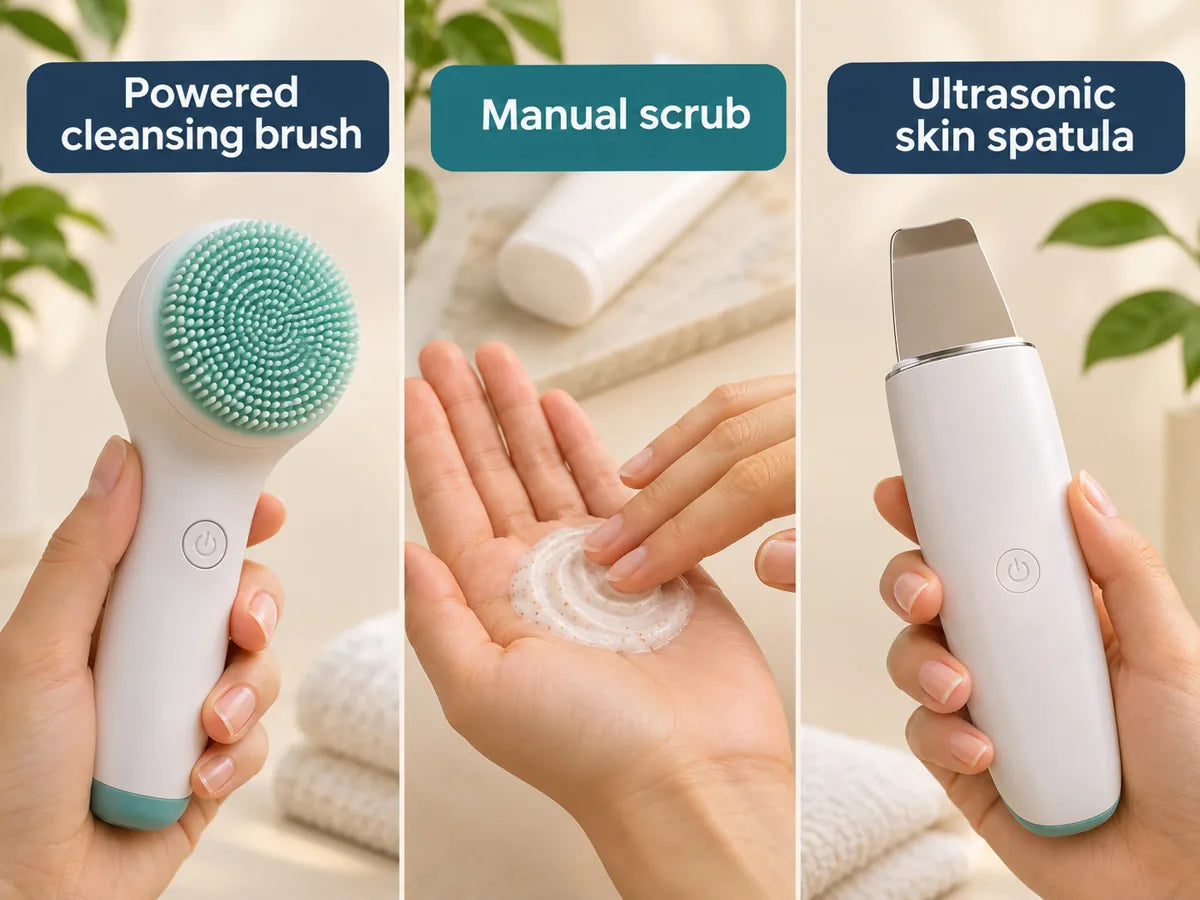
- Powered cleansing brush: A handheld device with soft silicone touch points or nylon bristles that vibrates or spins to work cleanser over wet skin. A sonic cleansing brush vibrates at audible speeds, around 100 Hz (vibrations per second) on one model's spec sheet.
- Manual scrub or exfoliating cleanser: A product you massage in with your fingertips. It involves no device. To make a gentle one yourself, see our guide to a face scrub at home.
- Ultrasonic skin spatula: A flat metal blade that vibrates above 20 kHz on wet skin. The "hold it at about a 45° angle" advice you may see online comes from one maker's spatula instructions and applies to spatulas only.
This guide covers silicone and sonic brushes. Any brush is a form of mechanical exfoliation, which means it removes dead skin cells by rubbing instead of with acids. That rubbing is the reason a gentle technique matters.
What you need before you use a face scrubber
Have these ready before you switch the brush on:
- A charged brush: Make sure the device is fully dry before you plug it in, and don't use it while it charges.
- A gentle cleanser: Use your usual mild cleanser. Skip grainy, clay or silicone-based formulas, which one maker warns against on silicone brushes.
- Lukewarm water: Hot water is harsher on skin than lukewarm water.
- Clean hands and a soft towel: You'll use the towel to pat your face dry, not rub it.
- Calm skin: Skip the brush on cuts, wounds, sunburn or skin that is already irritated.
- No extra exfoliant: Don't use a gritty scrub or strong exfoliating cleanser in the same session. If your skin is sensitive, also skip the brush on days you use retinoids, retinol or benzoyl peroxide.
- An IPX7 rating for shower use: IPX7 means the device survives temporary immersion up to 1 m (about 3.3 ft) for 30 minutes. A "waterproof" label without the code doesn't tell you this.
How often can you use a face scrubber, and at what speed?
Once a day is enough for most skin, and dry, sensitive or acne-prone skin usually does better starting less often on the lowest speed. No single frequency fits everyone. How often you exfoliate depends on your skin type and the method, and the more aggressive the method, the less often you need it.
| Skin type | Suggested start | Note |
|---|---|---|
| Sensitive or dry | Lowest speed (speeds 1–2 on a 5-speed brush), not every day at first | Brushes can irritate this skin type; a washcloth may suit you better |
| Acne-prone | Lowest speed, less often | Skip areas with inflamed pimples |
| Normal or combination | Middle speed (speed 3 on a 5-speed brush), once a day | Raise the speed only if your skin stays comfortable |
| Oily | Speeds 4–5 on oily areas, once a day | Oily or thicker skin often handles brushing better |
| Rosacea | Skip the brush | Wash with your fingertips only |
The speed guidance comes from the Waterproof Silicone Sonic Facial Cleansing Brush, which has five speeds. The Sonic Facial Cleansing Brush with Warm Massage Side has six intensity levels, and you start at the lowest one.
Note: Keep sessions short, because one manufacturer advises no more than 3 minutes of use a day for its brush.
How to use a double-sided facial cleansing brush with a warm side
A double-sided facial cleansing brush like the Sonic Facial Cleansing Brush with Warm Massage Side cleans with its front and warms with its back. You use the warm side after cleansing, as a relaxing massage step:
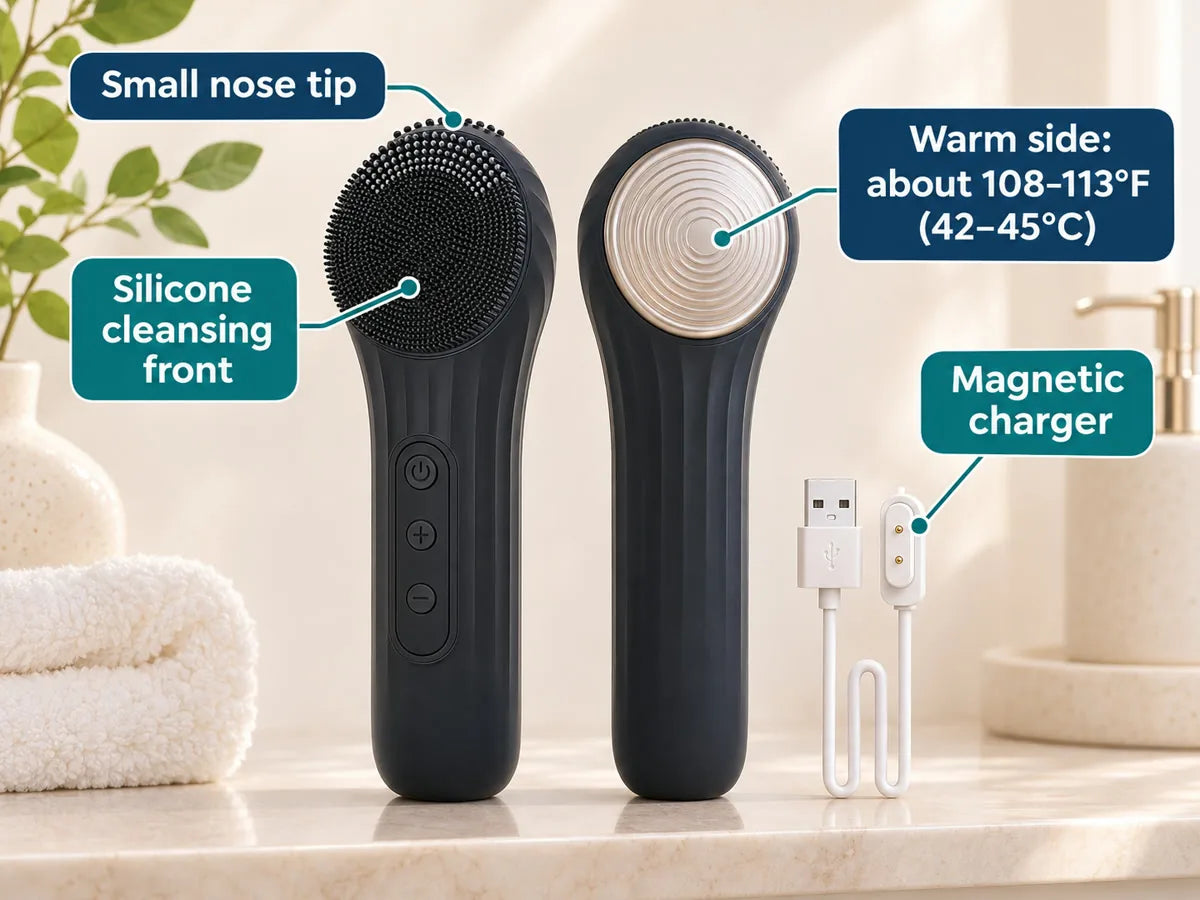
- Cleanse with the silicone front, following Steps 1–5 above and starting at a low level.
- Rinse your face, pat dry and apply your serum or lotion.
- Turn on the warm side, which heats to about 108–113°F (42–45°C).
- Glide it over your face for a minute or two, keeping it moving and away from your eyes.
- Stop if the warm side feels too hot.
- When you're done, rinse the brush, let it dry and click on the magnetic USB charger.
Common face scrubber mistakes and how to fix them
Watch for these common mistakes:
- Pressing hard: Rest the brush flat with light contact, because extra pressure adds friction without cleaning better.
- Adding a scrub or strong exfoliant: Use a mild cleanser, so you only exfoliate once.
- Starting at a high speed: Begin on the lowest setting and move up one step at a time.
- Brushing too long: Aim for about a minute; one manufacturer caps use at 3 minutes a day.
- Going near the eyes: Keep the brush off your eyelids and the eye area.
- Brushing broken or sunburned skin: Wait until cuts, wounds and sunburn have fully settled.
- Storing the brush wet: Let it air-dry completely before you put it in a bag or drawer.
- Sharing the brush: Keep it for one person, for hygiene.
- Skipping the manual: Settings and warnings differ by model, so read yours once.
Is a face scrubber safe for sensitive or acne-prone skin?
A face scrubber can be too much for sensitive or acne-prone skin, so many people with these skin types do better skipping it or using it rarely on the lowest setting. Whether your skin tolerates a brush depends on your skin type, your other products and how gently you use it.
- Dry, sensitive or acne-prone skin: Mechanical exfoliation can irritate it, and a washcloth plus a mild chemical exfoliant may suit you better.
- Retinoids, retinol or benzoyl peroxide: These make skin drier and more sensitive, so brushing on top can add irritation.
- Darker skin tones or a history of dark marks: Aggressive exfoliation can leave dark spots in some people.
- Rosacea: Wash with your fingertips only and skip the brush.
- Recent cosmetic procedures or a skin condition: Check with your doctor before using a device.
A brush is a cleansing tool, not an acne treatment. One 4-week study of a single sonic-brush routine reported improvement in acne among 46 participants, but it tested one device and cleanser, so it doesn't apply to face scrubbers in general.
Note: Stop using the brush if your skin turns red or irritated, and see a dermatologist if the irritation doesn't settle. Keep both brushes out of reach of children.
Face scrubber problems: redness, dryness or a brush that won't charge
Most problems have a simple cause and fix:
- Redness or stinging: This usually comes from too much speed, pressure or frequency. Stop for a few days, then return on the lowest setting, less often. See a dermatologist if the redness lasts.
- Dryness or tightness: You may be over-exfoliating or stacking actives. Skip other exfoliants, use the brush less often and moisturize right after.
- The Waterproof Silicone Sonic Facial Cleansing Brush won't charge: Dry the charging port fully, then reconnect the USB cable to a working 5V/1A USB source.
- The Sonic Facial Cleansing Brush with Warm Massage Side won't charge: Check that the magnetic charger has clicked on firmly and that the cable and USB source work.
If the brush still won't charge, contact our support team. Both brushes come with a 12-month limited warranty against manufacturing defects. See our warranty details.
How to clean a face scrubber and dry a silicone brush
Clean a face scrubber by rinsing it after every use and washing the silicone with soap and warm water. Then let it dry fully before you store it. This routine keeps cleanser residue from building up between the touch points.
- After each use: Rinse the brush head under the tap and shake off the excess water.
- Regular wash: Lather the silicone with mild soap and warm water, rinse well and pat dry or let it air-dry.
- Cleaners to avoid: Don't use cleaners containing alcohol, petrol or acetone, which one manual warns against on silicone.
- Storage: Keep the brush dry, out of direct sun and away from heat.
An IPX7 rating means you can rinse the brush under running water without worry. Silicone touch points have no replaceable head, unlike nylon bristle brushes, whose heads makers advise replacing about every 3 months.
Note: Keep the charging port on the Waterproof Silicone Sonic Facial Cleansing Brush dry before you charge it, because water and electricity don't mix.
Which facial cleansing brush fits the way you cleanse?
Choose the Waterproof Silicone Sonic Facial Cleansing Brush if you want a simple daily brush, especially for oily or combination skin. Choose the Sonic Facial Cleansing Brush with Warm Massage Side if you also want a warm massage after serum or lotion. Both are sold by Decor Your Life and come with a 12-month limited warranty.
| Feature | Waterproof Silicone Sonic Facial Cleansing Brush | Sonic Facial Cleansing Brush with Warm Massage Side |
|---|---|---|
| Best for | Daily cleansing, oily and combination skin, shower use | Daily cleansing, warm massage after skincare, shower use |
| Brush zones | Three silicone zones for forehead, nose area and cheeks | Dense daily area, firmer area for oily spots, small nose tip, warm side |
| Settings | 5 speeds with timer | 6 intensity levels, warm massage mode |
| Warm side | None | About 108–113°F (42–45°C) |
| Charging | USB cable (5V/1A); keep the port dry | Magnetic USB cable; no open port |
| Water rating | IPX7 | IPX7 |
| Warranty | 12-month limited | 12-month limited |
If your skin is sensitive, the silicone sonic brush's labeled speed guide (1–2 for sensitive skin) makes it easy to know where to start.
[dyl-products: silicone-sonic-facial-cleansing-brush, sonic-facial-cleansing-brush-warm-massage]
Frequently asked questions
Many people still have a few doubts after reading the routine, mostly about whether a brush is worth it at all. Common questions about face scrubbers include:
Do you actually need a face scrubber?
You don't need a face scrubber to get clean skin, because your fingertips or a soft washcloth with a gentle cleanser also do the job. A brush is an optional extra that suits people who like a deeper-feeling cleanse and whose skin stays comfortable with it.
Is a face scrubber better than washing with your hands?
A face scrubber isn't automatically better than your hands. It adds mechanical action, but it also adds friction. For many people with dry, sensitive or acne-prone skin, a washcloth is the gentler choice, so neither method wins for everyone.
Do dermatologists recommend facial cleansing brushes?
Not across the board. The American Academy of Dermatology says mechanical exfoliation, which includes brushes, can be too irritating for dry, sensitive or acne-prone skin. If you have a skin concern, ask a dermatologist whether a brush fits your skin.
Can a face scrubber remove blackheads?
A face scrubber helps clean the skin's surface, but it can't promise to clear blackheads, and the evidence for that is limited. Spatulas and extractions are different tools. For blackheads that keep coming back, a dermatologist can suggest options that suit your skin.
Learning how to use face scrubber brushes well is mostly about restraint: a mild cleanser, a low speed, light circles for about a minute, then a rinse and a full air-dry. If you're ready to pick one, browse our facial cleansing brushes. Every order ships free in the US.