

Sonic cleansing shows up on many face brush listings now, usually next to promises of a deeper clean. If you wash with your hands today or have tried a spinning brush, you probably want to know whether the vibration does anything your fingertips don't. Below, you'll see how the vibration works and which skin types it suits best.
What is sonic cleansing?
Sonic cleansing is a way of washing your face with a handheld device that vibrates very fast at the surface touching your skin, used with water and your usual facial cleanser. That surface can be soft silicone touch points or a bristle brush head that moves back and forth, while a classic rotating cleansing brush spins in circles.
There is no category-wide standard for what counts as "sonic," so speed, materials and design differ from model to model. It is also an extra rather than a requirement, because dermatology guidance still recommends a mild cleanser and gentle fingertips for everyday face washing. A sonic brush is one kind of face scrubber, and our guide to the other types shows how it compares with silicone pads, bristle brushes and ultrasonic spatulas.
How does a sonic facial cleansing brush work?
A sonic facial cleansing brush works by shaking its contact surface very quickly while you glide it over skin that already has water and cleanser on it. The vibration moves the cleanser around and over the skin's surface, and the silicone touch points or bristles add a light scrubbing feel.
Each product states its speed differently. One silicone device lists 100 Hz, which means 100 vibrations per second, while another manufacturer lists 7,000 vibrations per minute. Because they are measured and stated in different ways, these numbers don't let you rank brushes, and neither tells you how clean your skin will be.
Note: Let the brush glide flat against your skin instead of pressing, because brush makers say extra pressure makes the head work less well, not better.
What can sonic cleansing do for your skin?
The realistic effects of sonic cleansing are cosmetic and modest, and the research behind them is small. The benefits that hold up best include:
Skin that looks and feels clean after washing
The most realistic result is cosmetic: skin that looks and feels clean and fresh once you rinse. A 46-person study in people with acne reported improvement after four weeks, but participants used a sonic brush, a specific brush head and a cleanser together, with no comparison group. That design can't show what the device alone did, so read "deep clean" on packaging as a sales phrase rather than a proven result.
Makeup and pollution removal in small studies
Results for removing residue are mixed. In a 20-person, single-session study, a sonic brush removed more of an artificial pollution mixture than washing by hand. A 12-person split-face study, where each person cleansed one side of the face each way, found no significant differences in several skin measures up to 90 minutes after cleansing. Both studies are small, and the pollution mixture was artificial, not your everyday makeup and sunscreen.
A steadier routine with speed levels and a timer
Speed levels and a built-in timer help you keep each session short and even, so you don't overwork one spot. The Waterproof Silicone Sonic Facial Cleansing Brush (F3), for example, has five speeds and a built-in timer. One manufacturer's manual advises using its device for no more than 3 minutes a day. This is a convenience benefit, not a change in your skin.
What sonic cleansing can't do
Keep these limits in mind before you buy:
- Not an acne or skin-condition solution: No sonic brush is a substitute for acne or skin care from a dermatologist, and the AAD warns that scrubbing can make acne worse.
- No proven absorption, firming or lifting: Claims about better serum absorption or a firmer, lifted look are product claims that the available studies don't support.
- Pores don't shrink: The AAD says pores can only be made to look less noticeable, and that scrubbing won't make them any cleaner.
- Not needed for basic washing: A mild cleanser applied with your fingertips does the everyday job.
- Thin evidence: The key studies are small, short and often linked to brush makers.
- Labels need proof: The FTC requires objective ad claims to be backed by evidence, and the FDA listing one "Rotating Sonic Cleansing Brush" as a Class I device does not mean every sonic brush has been cleared by the FDA.
Sonic vs rotating brushes: is sonic cleansing really gentler?
Sonic cleansing is not automatically gentler than other methods, because the word "sonic" describes the motion, not how your skin reacts. The comparisons that matter most include:
Sonic vs rotating facial brush
Choose a sonic brush if you want a surface that vibrates in place; choose a rotating brush only if your skin is oily and not sensitive. A rotating or oscillating brush has a round bristle head that spins or swings back and forth, usually with replaceable heads, and spinning bristles tend to feel more abrasive.
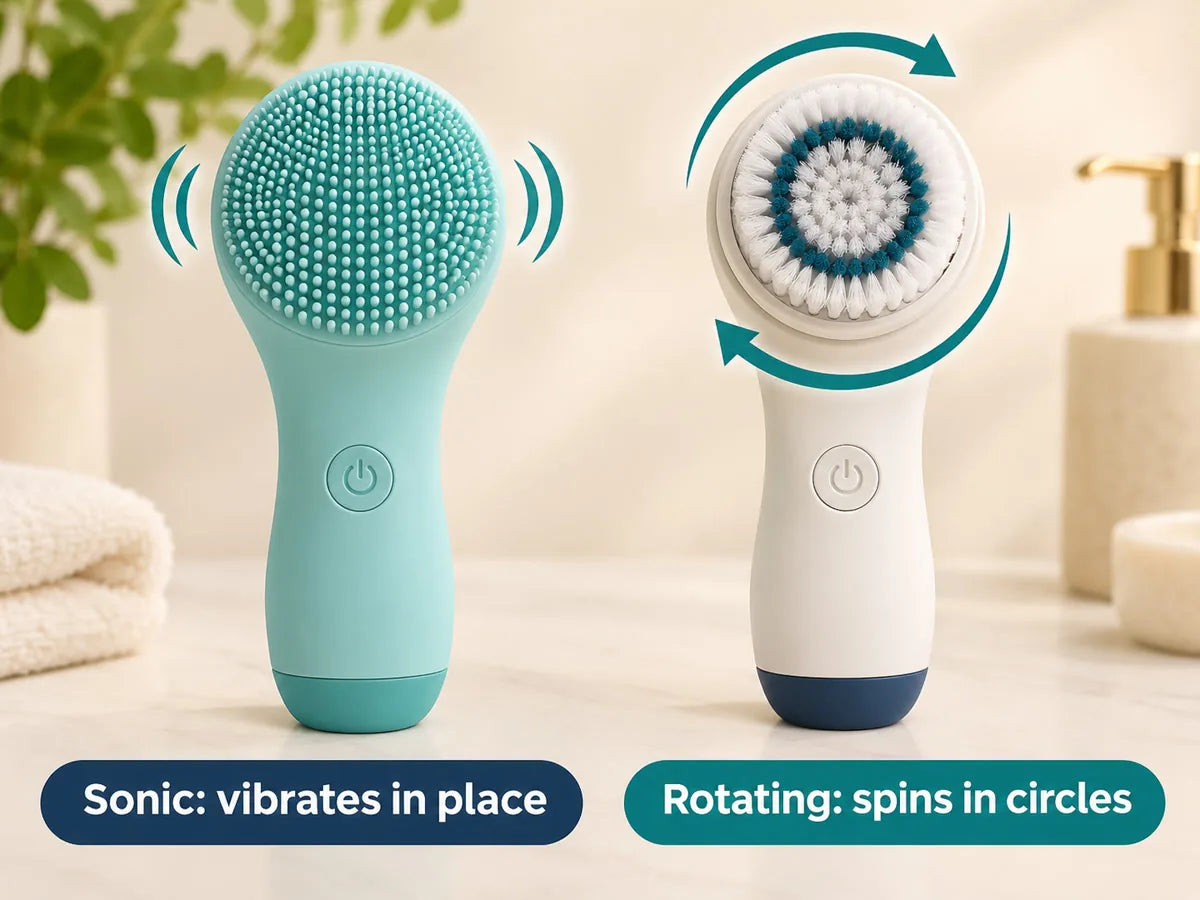
No study shows sonic brushes are gentler as a group, and some brushes sold as sonic also oscillate. The head material, how hard you press and how often you use it shape the experience more than the label does.
Sonic brush vs washing with your hands
Washing with your hands is enough for most people, and a sonic brush is an optional upgrade in feel and routine. The AAD recommends applying a mild cleanser with your fingertips, and notes that other tools can irritate skin.
Since the small studies are mixed, the case for a brush rests on preference. Pick one if you like a timed, guided wash and your skin handles it well. Stick with your hands if your skin is sensitive or reactive, or if you don't want to rinse, dry and charge another device.
Silicone vs bristle brush heads
Silicone and nylon bristle heads differ mainly in feel and upkeep:
| Silicone touch points | Nylon bristle head | |
|---|---|---|
| Contact surface | Soft molded bumps | Fine nylon filaments |
| Feel on skin | Softer, less scrub | More scrub feel |
| Cleaning | Soap and warm water after use | Head and handle weekly with warm soapy water |
| Drying | Dries fast, rinses clean | Needs a full rinse and dry |
| Replacement heads | None to buy | About every 3 months |
| Best for | Low upkeep, most skin | Normal to oily, non-sensitive skin |
Both the F3 and F4 described below use silicone touch points, so there are no heads to replace.
Types of sonic facial cleansing brush: cleansing-only or with a warm side
Sonic facial cleansing brushes generally come in two forms: cleansing-only, or with a warm back side for massage after skincare. Two examples are the Waterproof Silicone Sonic Facial Cleansing Brush and the Sonic Facial Cleansing Brush with Warm Massage Side. Here is how they compare:
Waterproof Silicone Sonic Facial Cleansing Brush (F3)
The Waterproof Silicone Sonic Facial Cleansing Brush (F3) is a cleansing-only silicone face brush that vibrates to work your cleanser over the skin through soft touch points. Its three zones have different densities for the forehead, nose area and cheeks, so you can match the zone to each area of your face. IPX7 waterproofing means the device is built to survive being under up to about 3.3 ft (1 m) of water for 30 minutes, so you can use it in the shower and rinse it under the tap.
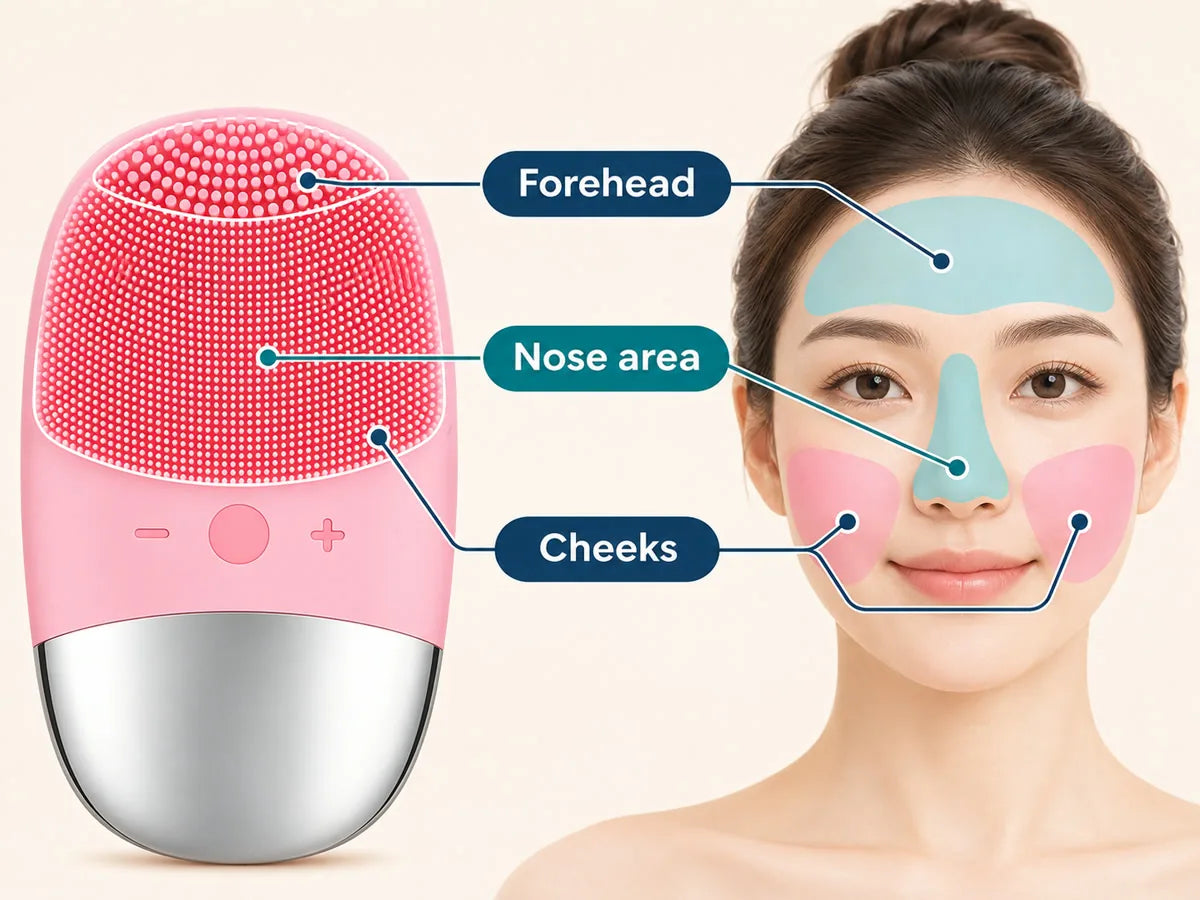
- Best for: Daily cleansing, oily and combination skin, shower use.
- Settings: Five speeds with a timer: 1–2 for sensitive skin, 3 for daily cleansing, 4–5 for oily areas.
- Size: About 4.1 x 2.6 x 1 in (10.5 x 6.5 x 2.5 cm), USB charging (5V/1A).
- Cons: The charging port must be dry before you plug it in.
It comes with our 12-month limited warranty against manufacturing defects.
Sonic Facial Cleansing Brush with Warm Massage Side (F4)
The Sonic Facial Cleansing Brush with Warm Massage Side (F4) cleans with sonic vibration on the front and warms on the back. The warm side reaches about 108–113°F (42–45°C) for a relaxing massage after you apply serum or lotion. Its magnetic USB charger clicks on, so there is no open port to keep dry.
- Best for: Daily cleansing, a warm massage after skincare, shower use.
- Zones: A dense area for daily use, a firmer area for oily spots, a small tip for around the nose, and the warm massage side.
- Settings: Six intensity levels; start low and raise only if it feels comfortable.
- Extras: IPX7 waterproof, stands upright on the counter, same 12-month limited warranty.
Note: Stop using the warm side if it feels too hot, because the warm side is meant to feel comfortable, not hot.
If massage matters more to you than cleansing, look at our facial massagers.
Who is sonic cleansing for?
Sonic cleansing suits some people more than others, and the fit depends on how well your skin handles friction and how you like to wash. The two groups include:
Good fit
- Oily or combination skin: A firmer zone or a higher speed can reach oily areas without changing your whole routine.
- Shower users: An IPX7 waterproof brush can go in the shower and rinse under the tap.
- Routine lovers: Speed levels and a timer keep each wash short and even.
- Calm, healthy skin: Skin that isn't irritated or broken is the safest starting point.
Take care or avoid
- Rosacea: The AAD advises washing with fingertips only and avoiding rubbing or scrubbing, so skip the brush.
- Broken or irritated skin: Don't use any brush over cuts, sunburn or irritated patches.
- Dry or sensitive skin: The AAD says brushes can be too irritating, so use the lowest speed or skip it.
- Strong actives: If you use retinoids, retinol or benzoyl peroxide, a brush on top can add dryness.
- Eyes and sharing: Keep it away from the eyes and eyelids, and don't share it.
- Recent procedures: If you've had a cosmetic procedure such as Botox, check with your doctor first, as one brush maker advises.
- Children: Keep the device out of their reach.
Is sonic cleansing safe for sensitive skin?
Not always: sonic cleansing suits sensitive skin only if your skin tolerates it, and soft silicone or a low setting is no promise that it won't irritate. How it goes depends on your skin, the speed you choose, how hard you press and how often you use it.
Start on the lowest speeds, such as 1–2 on the F3, keep sessions short and let the brush glide with light pressure. Stop if you notice stinging, redness or dryness. If you have a skin condition or are under a doctor's care, check with a dermatologist before you start.
Note: Dry the device fully before charging and never use it while it charges, because water and electricity don't mix.
How to use a sonic facial cleansing brush
Follow these steps, and check your manual for model-specific settings:
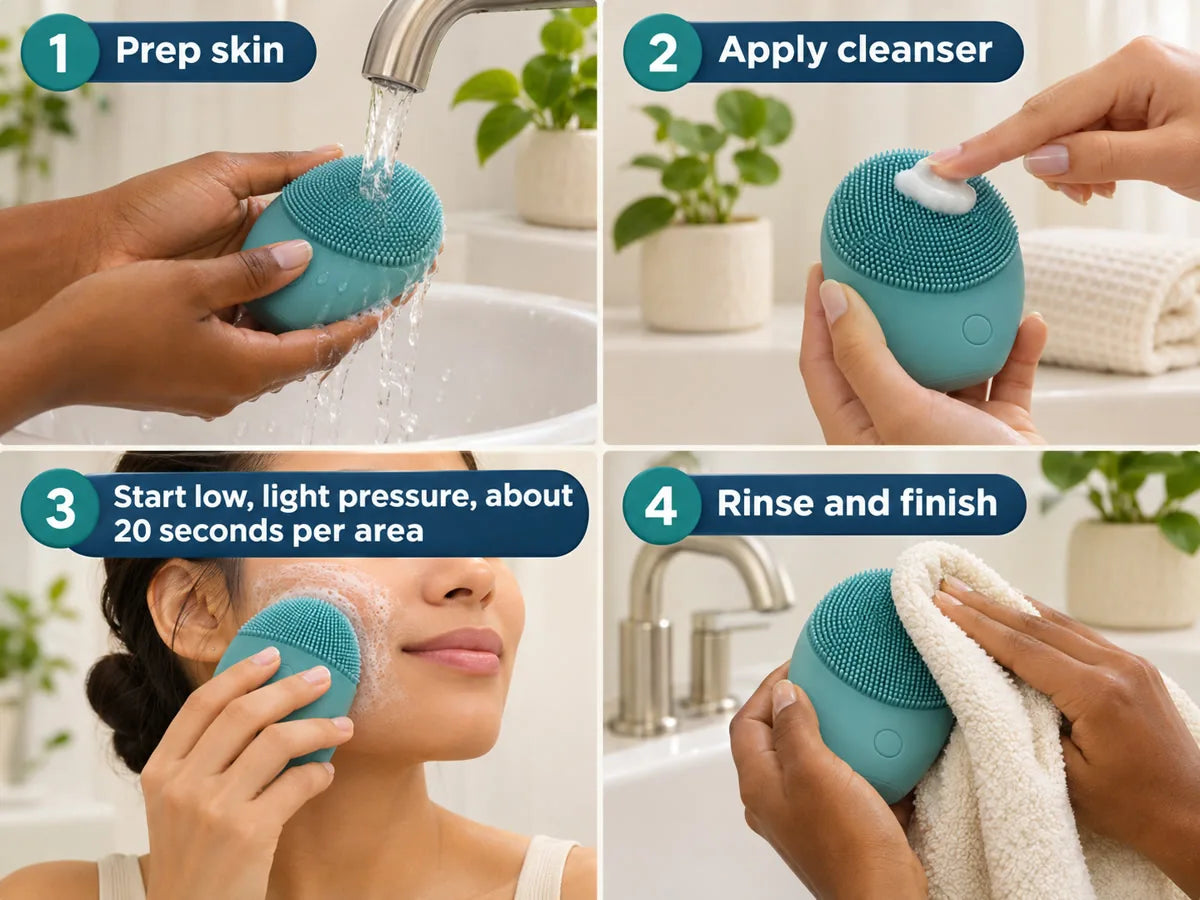
- Prep your skin: Remove makeup, then wet your face with lukewarm water and wet the brush.
- Apply cleanser: Use your usual cleanser, but skip grainy, clay or silicone-based formulas, which some silicone brush makers warn against.
- Start low: Pick a low setting and move in small circles with light pressure for about 20 seconds per area, staying clear of the eyes.
- Rinse and finish: Rinse your face and the brush, pat your skin dry and apply moisturizer.
- Warm side (F4 only): After serum or lotion, glide the warm side over your face for a minute or two.
How to clean a sonic facial brush
Rinse your sonic facial brush after every use, then let it air-dry before you put it away. Wash the silicone surface with soap and warm water, rinse it and pat it dry.
Avoid cleaning products that contain alcohol, petrol or acetone, because they can damage silicone. Store the brush dry and away from direct sun and heat. On a USB-port model like the F3, check that the port is completely dry before charging; the F4's magnetic charger has no open port, but the brush should still be dry.
[dyl-products: silicone-sonic-facial-cleansing-brush, sonic-facial-cleansing-brush-warm-massage]
Frequently asked questions
Do dermatologists recommend facial cleansing brushes?
Not routinely: the AAD recommends washing with a mild cleanser and your fingertips rather than a tool, and notes that brushes and other tools can irritate skin, so a sonic brush is an optional extra, best kept for calm, non-sensitive skin.
How often should you use a sonic facial brush?
Once a day is enough for most skin with the F3 and F4, though guidance differs between brands and dermatologists. Use it less often if your skin turns red or feels dry, and wash with fingertips on the other days.
Can a sonic facial cleansing brush help acne?
A sonic facial cleansing brush is not an acne remedy. A 46-person, four-week study tested a full routine of brush, brush head and cleanser, not the device alone, and scrubbing can make acne worse. See a dermatologist for breakouts that don't settle.
Can you use a sonic brush if you have rosacea?
A sonic brush is a poor fit for rosacea-prone skin. The AAD advises washing with your fingertips and avoiding rubbing, scrubbing, massaging, washcloths and sponges, because irritation can make rosacea worse. Ask a dermatologist what cleansing routine suits you.
Sonic cleansing is a comfortable, optional way to wash your face, not a deeper clean your fingertips can't match. It fits best on calm, oily or combination skin when you use low settings and light pressure. If it sounds right for your routine, compare options in our facial cleansing devices collection. Both brushes compared here come from Decor Your Life, with free US shipping on every order.