

Foot corns often start as a small, hard spot on a toe or the sole that hurts every time you put on shoes. You might wonder whether it is a corn, a callus or a wart, and whether you can cut it out yourself. You should not cut it. This guide explains what corns are, why they form and when to get a professional to look at one.
What are foot corns?
A foot corn is a small, sharply defined patch of thickened skin with a hard, cone-shaped center that presses inward. That center is why a corn hurts when you press on it or walk in tight shoes. Corns form under repeated pressure or friction, usually over a bony point on a toe or the sole.
People describe the same problem in several ways, such as "corn on sole of foot," "corn foot sole" or even "corn in leg." Corns form on the feet and toes, not on the leg. The hard center is often called a root, but it is a dense core of dead skin. It does not grow into the foot.
How do foot corns form?
Foot corns form when the same small area of skin is pressed or rubbed again and again. The outer layer responds by building up extra dead skin to protect itself. When the buildup spreads over a broad area, it becomes a callus. When it focuses on one small point, it grows a dense core and becomes a corn.
The pressure usually comes from shoes that are too tight or narrow, seams inside the shoe that rub one spot, or toe deformities such as hammertoes and bunions. These deformities push a joint against the shoe.
The thick skin is a reaction to pressure, so filing or soaking only smooths the surface for a while. If the shoe or toe position stays the same, the corn tends to return and can grow larger.
Types of foot corns and where they form
Foot corns come in three main types. Where a corn sits on your foot is often the best clue to its type, because each one forms under a different kind of pressure. The three types are hard, soft and seed corns.
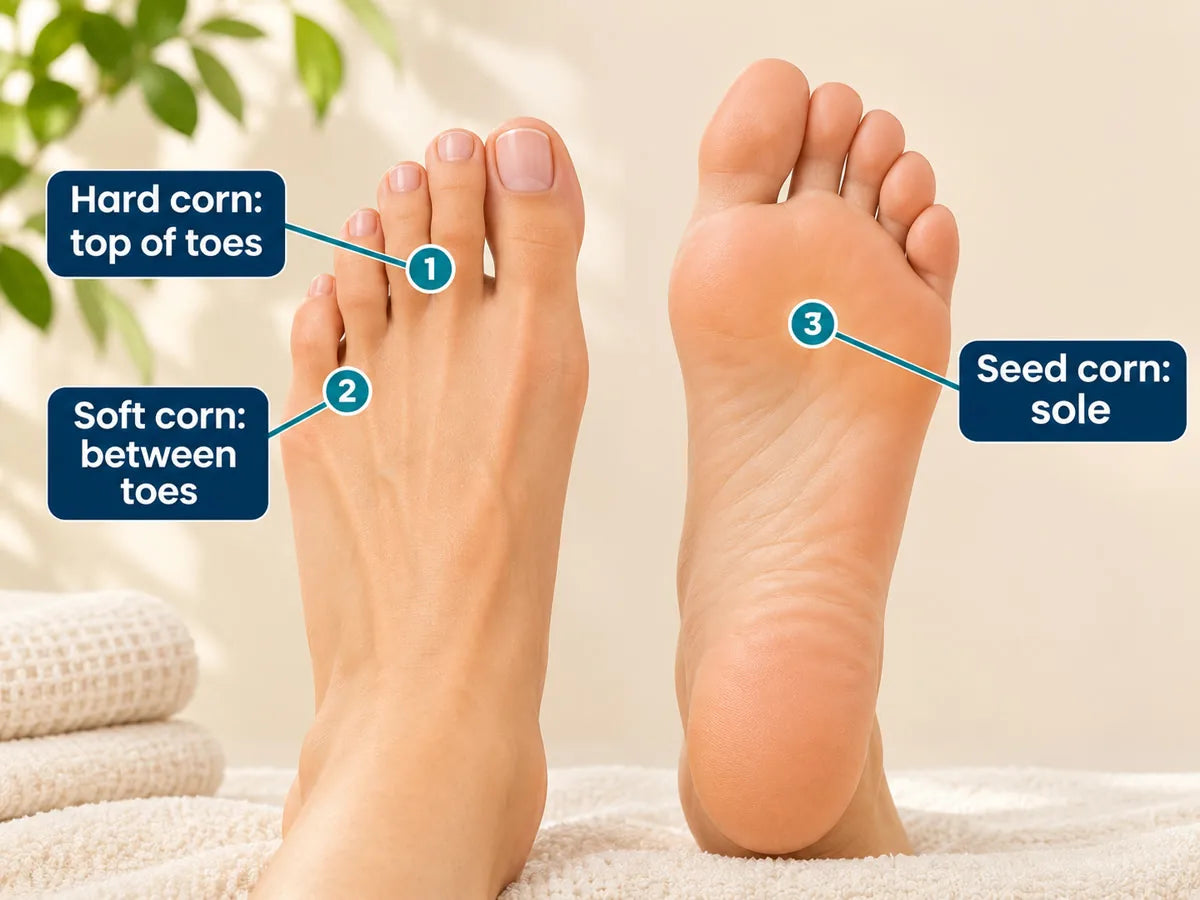
Hard corns on the toes
A hard corn is the most common type. It is a dry, dense spot with a firm center that forms over a bony point, usually on top of a toe joint or on the outer side of the pinky toe.
Hard corns form when the top of the shoe or a tight toe box presses on the same joint with every step. The toe box is the front part of the shoe around your toes. Hammertoes make hard corns more likely, because the bent joint rises up and rubs against the inside of the shoe.
Soft corns between the toes
A soft corn is a whitish-gray, rubbery corn that forms between the toes. It is most common between the fourth and fifth toes, where neighboring toe bones press against each other.
Sweat and moisture trapped between the toes keep the thick skin soft instead of hard. Narrow shoes or a hammertoe squeeze the toe space and add the pressure. Unlike hard corns, soft corns form in the gaps between the toes rather than on top of them.
Note: Keep files and acid products away from soft corns. The skin between the toes stays damp, so keeping it dry, cushioning it and using a toe spacer is the safer approach. The soft corn toes guide covers care for this area in more detail.
Seed corns on the sole and heel
A seed corn is a small corn that usually forms on the bottom of the foot. People sometimes describe a tiny hard spot as a "seed corn on heel." Heel skin carries your body weight, though, so it more often builds up a broad callus that can crack and hurt.
Small spots on the sole and corns on heels are the easiest to confuse with a callus or a plantar wart. All three can look like hard skin on a part of the foot that carries weight. If you are not sure what a small spot on your sole or heel is, ask a podiatrist (a foot doctor) to check it before you try to remove anything.
How can you tell a foot corn from a callus or plantar wart?
A corn is small with a hard central core. A callus is a broader, flatter area of thick skin. A plantar wart is a skin infection caused by a virus, so it is more than just thick skin.
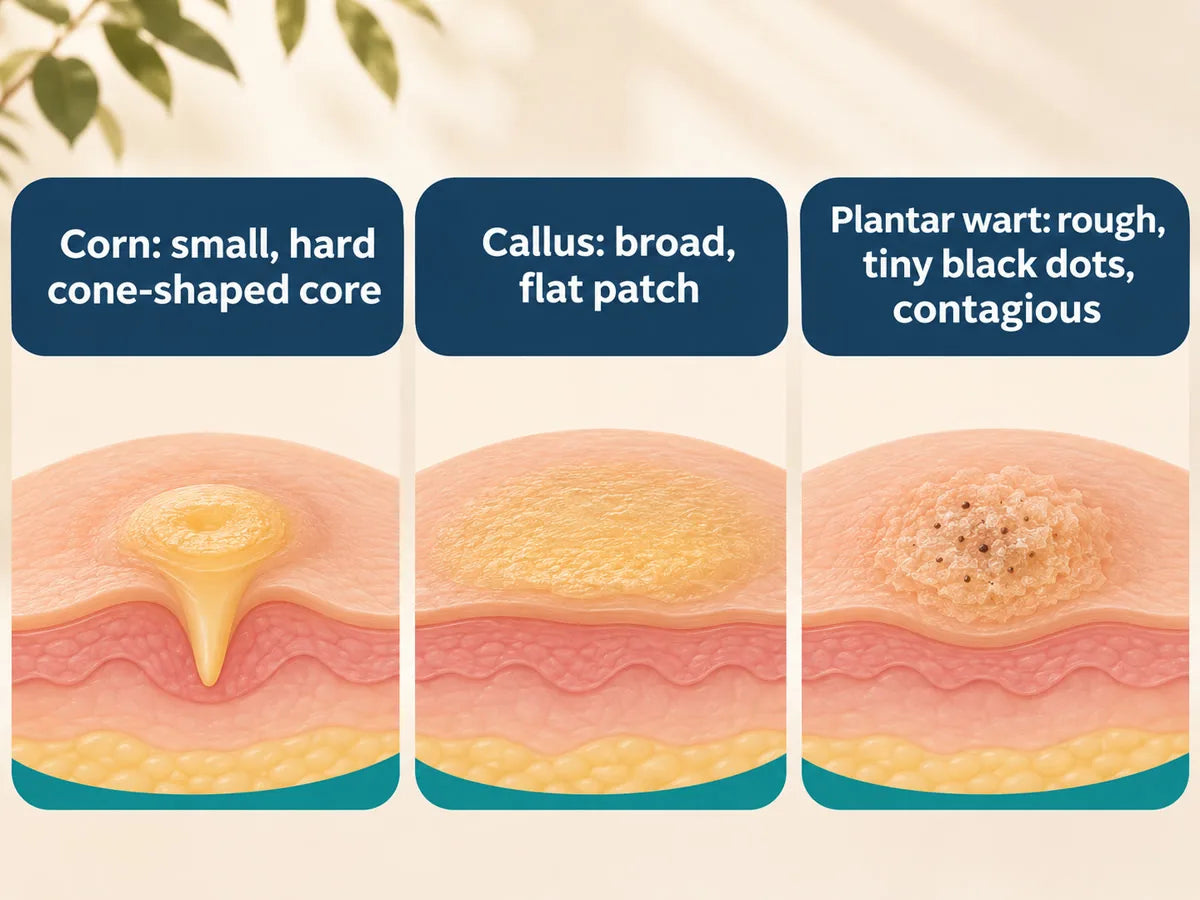
| Corn | Callus | Plantar wart | |
|---|---|---|---|
| Size | Small, sharply defined | Larger patch, no clear border | Varies |
| Shape | Round, with a hard cone-shaped core | Flat and fairly even | Rough patch with tiny black dots |
| Usual location | Tops of toes, between toes, sole | Heel, ball of foot, inner big toe | Sole of the foot |
| Pain | Hurts most with direct pressure | Often mild; heel cracks can hurt | Hurts more when squeezed side to side |
| Contagious | No | No | Yes (HPV virus) |
The tiny black dots in a plantar wart are clotted blood vessels. Corns and calluses do not have these dots.
Note: Do not use a file or pumice stone on a suspected wart. Warts are contagious and need different care than thick skin.
These signs help you describe the spot, but they do not confirm what it is. A podiatrist can confirm what it is. For a closer look at how care differs between the two, read the foot corn and callus treatment guide.
Who is more likely to get foot corns?
You are more likely to get foot corns if any of these apply to you:
- Tight or ill-fitting shoes: Narrow toe boxes press on the same toe joints all day.
- Seams and straps: Stiff seams inside shoes or sandal straps can rub one small area again and again.
- High heels: Frequent wear shifts your weight onto the ball of the foot, a common spot for thick skin.
- Toe deformities: Hammertoes and bunions push toe joints against the inside of the shoe.
- Long toenails: Nails that are too long push the toes back into the shoe.
A corn also carries more risk if you have diabetes, poor circulation or reduced feeling in your feet. With reduced feeling, a small sore can go unnoticed and break down into a wound. About half of people with diabetes have some nerve damage, so daily foot checks are part of the routine.
How are foot corns treated?
Foot corns are mainly treated by taking pressure off the spot. On healthy feet, you can then gently thin the hard skin around it:
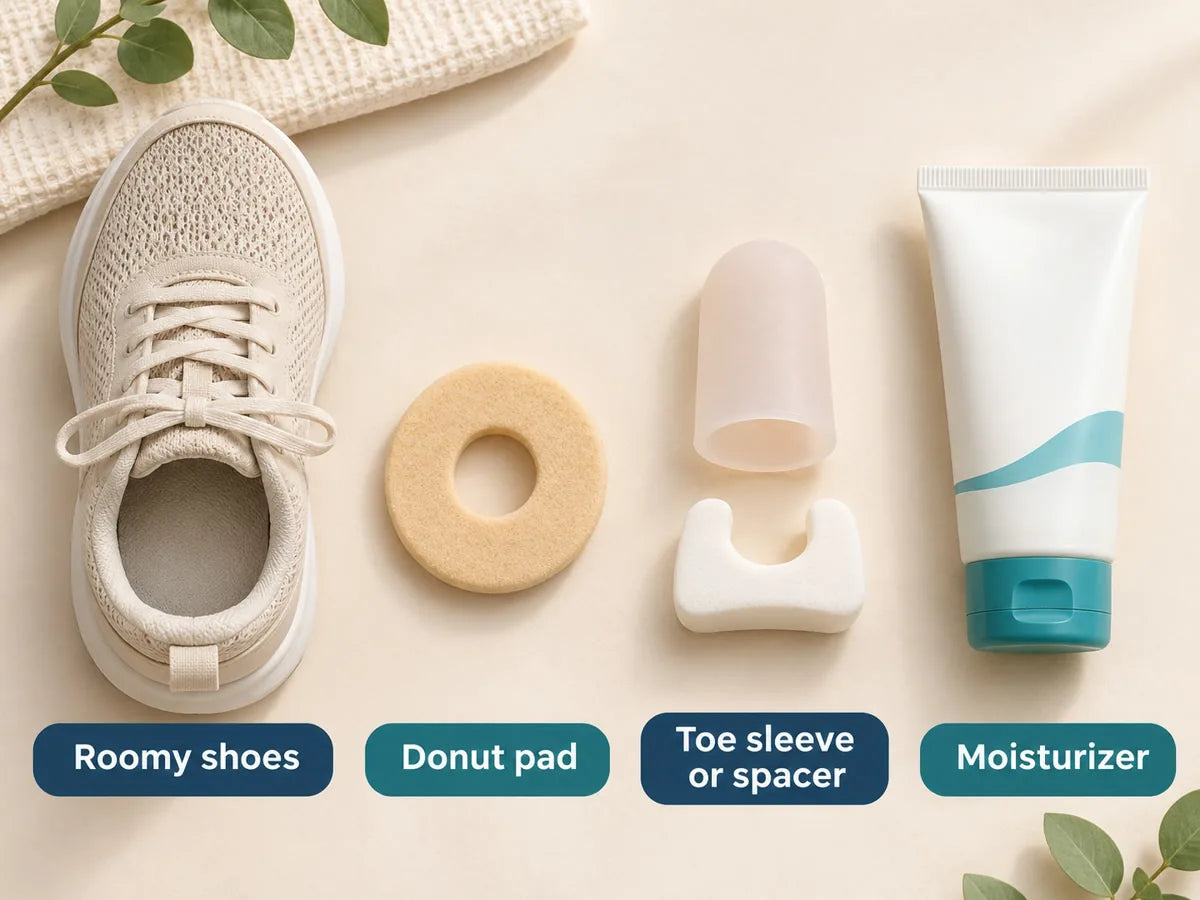
- Relieve pressure: Wear shoes with a roomy toe box, a low heel and a soft upper.
- Pad the spot: Use a donut-shaped pad around a corn, or a silicone toe sleeve or foam spacer for soft corns, to move pressure off the core.
- Soak and smooth: Soak your feet in warm water for about 5–10 minutes. Then gently rub the area with a wet pumice stone, and stop before the skin turns raw.
- Moisturize: A daily urea or ammonium lactate cream gradually softens hard skin.
Salicylic acid plasters (12–40%) and liquid medicine for corns on feet (12–17.6%) are over-the-counter corn removers. Apply them only to the corn and follow the label. Plasters come off after 48 hours, and you should stop using either product after 14 days.
Note: Skip acid corn products if you have diabetes, poor circulation, or irritated or broken skin, because the acid can burn the skin.
Note: Never cut or shave a corn with a razor, scissors or a blade-style foot corn scraper. Removing too much skin can cause bleeding and infection.
For the full step-by-step routine and product choices, read the get rid of corns on feet guide in our Beauty Device Guides.
When should you see a podiatrist about foot corns?
See a podiatrist about foot corns if a spot is very painful, bleeds, leaks fluid or pus, or keeps getting worse. You should also go if it does not improve with pressure relief and home care, or if you cannot tell whether it is a corn, a callus or a plantar wart.
Skip home removal and go straight to a professional if you have:
- Diabetes: Do not cut, file or use acid on a corn, and do not soak your feet. Ask your doctor what is safe.
- Poor circulation or numbness: You may not feel damage from filing or acid until the skin has broken.
- A weak immune system or fragile skin: Small breaks in the skin are more likely to become infected.
A podiatrist can pare thick skin with a blade in the office, which is very different from cutting a corn at home. They can also suggest padding or orthotics (shoe inserts that move pressure off the spot). People with diabetes should have a foot exam every year, or more often if they have nerve damage.
[dyl-products: rechargeable-electric-foot-file, electric-callus-remover-for-feet, cordless-foot-callus-remover-nail-buffer]
Frequently asked questions
Can foot corns come back?
Foot corns can come back if the shoes, seams or toe shape that caused them keep pressing on the same spot. Shoes with a roomy toe box, protective padding, cushioned socks and toenails trimmed straight across all lower the pressure that lets a corn return.
Foot corns are your skin's response to pressure and friction. Start by taking that pressure off with roomier shoes and padding, and see a podiatrist if you are unsure what the spot is or if you have diabetes or poor circulation. For home care, read the get rid of corns on feet guide and the foot corn and callus treatment guide. To smooth rough heel skin, browse our foot care devices. The files Decor Your Life sells are made for heels and soles, not for the corn itself.