

Rough heels catch on socks and look dry in sandals, yet choosing between callus remover gel and an electric foot file can feel risky. A gel can irritate skin or do little, while a file pressed too hard can leave feet sore. Both tools can leave hard skin on heels feeling smoother, but they work in very different ways. Below, you can see how they compare on speed, mess, results and safety.
Callus remover gel vs electric foot file: which is better for you?
Choose callus remover gel if you want hands-off softening on thick callus and will follow the label exactly. Choose an electric foot file if you want quick, dry, controlled smoothing without chemicals. You can also use both: soften first, then file gently.
Choose a gel if…
A gel makes more sense in these cases:
- Your callus is thick and hard: a softener can loosen dense skin before any filing.
- You'd rather not use a motor: you apply, wait and rinse, with no spinning roller involved.
- You'll follow the label exactly: timing, gloves and rinsing differ from one formula to the next.
- You can keep it on the callus only: the acids can irritate the healthy skin around it.
- Your skin is healthy and unbroken: no cuts, bleeding cracks, redness or irritation.
Choose an electric foot file if…
An electric foot file is the better fit in these cases:
- You want quick, visible smoothing without chemicals: the roller buffs dry skin off as you go.
- Your skin reacts to acids: a file has no salicylic acid or AHAs to sting.
- You keep up with rough heels regularly: a short session between pedicures keeps heels feeling smooth.
- You're comfortable with light pressure: pressing hard can stall the roller and leave skin sore.
- You want a reusable tool: replaceable rollers or discs swap out when they wear down.
What is a callus remover gel and what is an electric foot file?
The two tools tackle hard skin from opposite sides. A callus remover gel is a chemical softener, while an electric foot file is an abrasive that buffs skin away. Here is how each one works:
Callus remover gel
Callus remover gel is a topical softener that you spread on thickened skin so it loosens and comes away more easily when you rinse or file. The same idea is sold as callus remover cream, callus remover liquid and callus softener spray, so read the label rather than trusting the format name.
Ingredients differ. One listed gel uses 12% salicylic acid, while some kits combine salicylic, lactic and glycolic acids (AHAs, or alpha hydroxy acids) with potassium hydroxide. Urea creams are rich moisturizers that soften thick, dry skin. Some gels are labeled as over-the-counter drugs, which comes with set directions and warnings.
- Best for: thick, hard callus on healthy, unbroken skin.
- Time: a soak, a wait set by the label, then a full rinse.
- Cons: can irritate healthy skin; directions are not interchangeable between products.
Electric foot file
An electric foot file is a battery-powered handle with a spinning abrasive roller or disc that buffs away dry, thick skin, a bit like fine sandpaper that does the moving for you. You use it on clean, dry feet with light pressure, so there is nothing to wait for or rinse off your skin. Most models charge by USB and take replaceable rollers or discs in coarse and fine grades.
- Best for: rough heels and regular upkeep.
- Time: a few seconds per spot, with frequent checks.
- Cons: leaves skin dust; over-filing can leave feet sore.
Callus remover gel vs electric foot file: key differences
The biggest differences come down to how each tool removes hard skin and what can go wrong. A gel softens and asks for patience and care with the edges, while a file works right away but depends on your pressure and timing. This table compares both on the same points:
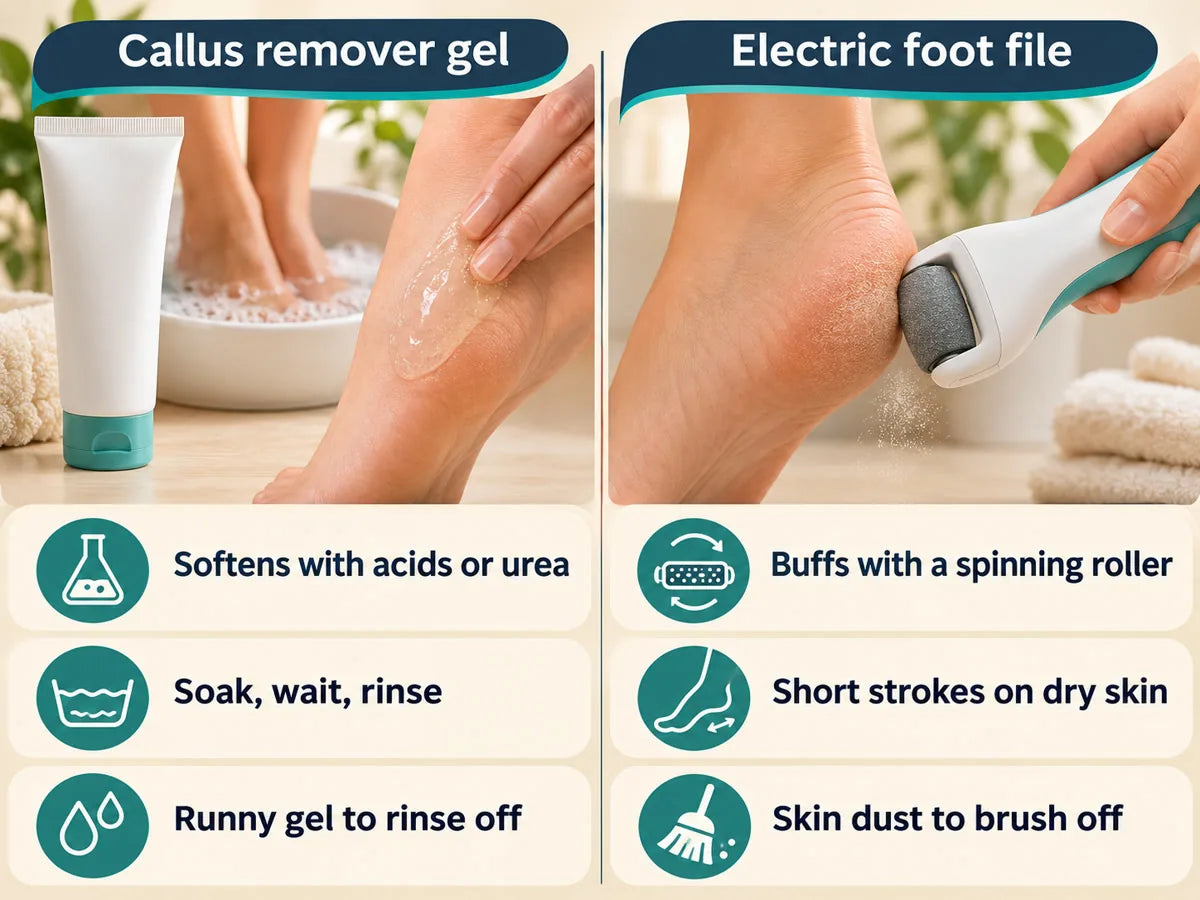
| Criteria | Callus remover gel | Electric foot file |
|---|---|---|
| How it works | Acids or urea soften thick skin | Spinning roller or disc buffs skin off |
| Speed | Soak, wait per label, rinse; sometimes filing after | Short strokes, a few seconds per spot |
| Effort | Hands-off while it sits | Steady, light pressure |
| Mess | Runny gel can spread; must rinse fully | Dry skin dust to brush off |
| Evidence | Limited for gels on calluses | No peer-reviewed trials found for home files |
| Irritation risk | Stinging or burns on healthy skin | Soreness from pressure or over-filing |
| Who should skip | Diabetes, poor circulation, broken or irritated skin | Broken skin, warts, wounds; ask a doctor first with diabetes |
| Upkeep | Buy a new tube when empty | Rinse the roller; replace worn rollers or discs |
Speed and effort
An electric foot file is faster per session, because gel adds soaking, waiting and rinsing before any smoothing starts. Gel timings vary widely: one kit says to soak for about 5 minutes and leave the gel on for up to 5 minutes, while one 12% salicylic acid gel says to soak for 10–15 minutes and leave the gel on for 10–15 minutes. Some kits include a file to use after rinsing.
A file skips the soak and works on dry skin in short strokes, and one file's directions call for 2–3 seconds per spot before you check. If you smooth by hand with a pumice stone instead, dermatology guidance suggests a 5–10 minute warm soak first.
Results and evidence
Neither tool has strong proof behind it, so expect smoother-feeling heels rather than a set result. For gels, the one clinical trial available looked at salicylic acid plasters for corns, not consumer gels for calluses, and "fast-acting" or salon-style wording is a brand claim. Treat a gel as a callus softener, not a full fix, since evidence for gels is limited and results vary.
An electric foot file shows you the change as you go, because it buffs skin off physically, although no peer-reviewed trials of home files were found either. With either tool, calluses come back while the friction behind them continues, so better-fitting shoes and padding make a difference. Both work on calluses, not corns: if a spot is small, hard and painful, read how corns and calluses differ, and for a callus on the side of the big toe see our guide to big toe calluses.
Mess and ease of use
Gel is the messier choice. Runny formulas can drip past the callus, while thick or slippery ones can be hard to rinse off, and some labels tell you to wear gloves. An electric foot file stays dry but leaves fine skin dust to brush off, and on models with a washable roller you rinse the roller after use.
Note: On some electric foot files the body is not waterproof, so rinse only the detachable roller and keep the handle dry.
Skin irritation risk
Callus remover gel carries the bigger burn risk, because the acids that soften callus can also irritate or burn the healthy skin around it. Keep it on callused skin only, away from cuts, and follow the label's eye-contact and stop-use warnings.
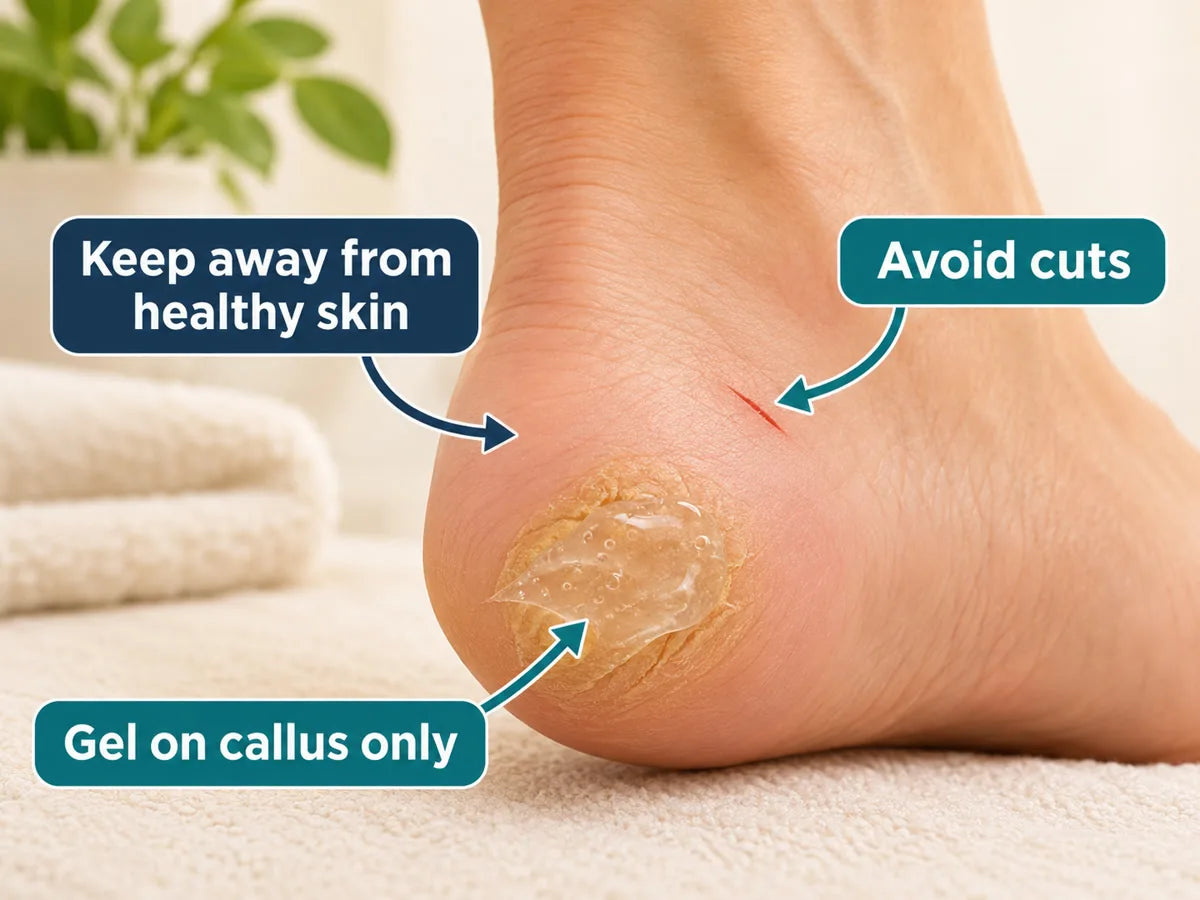
An electric foot file's main risk is soreness from pressing hard or staying too long on one spot, so use light pressure and stop as soon as the skin feels smooth.
Note: Never cut a callus with a blade or razor at home, because removing too much skin can cause bleeding and infection.
Can you use callus remover gel and an electric foot file together?
You can use callus remover gel and an electric foot file together, as long as the gel's label allows filing afterward and your skin is not irritated. The gel softens, and the file smooths what is left with less effort:
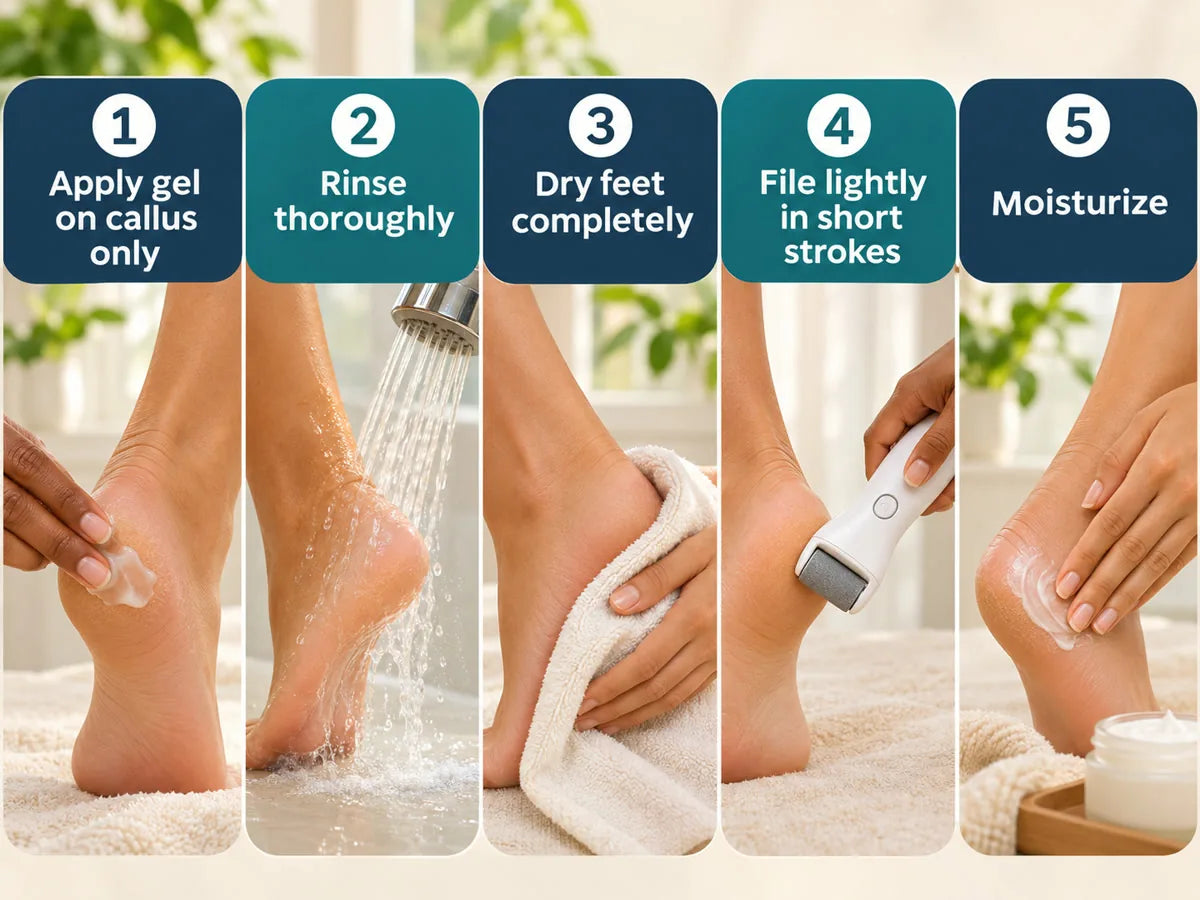
- Apply the gel to callused skin only, following your product's own soak and wait times.
- Rinse thoroughly so no gel stays on your skin.
- Dry your feet completely, because most electric files are made for dry skin.
- File with light pressure in short strokes, and stop as soon as the area feels smooth.
- Moisturize afterward. For dry heels, a cream with 10–25% urea applied within 5 minutes of washing helps soften the skin.
Note: Skip the combination on red, stinging or irritated skin, because filing over skin the gel has already irritated can leave it sore.
Is callus remover gel or an electric foot file safe with diabetes or sensitive skin?
No, not without a doctor's go-ahead if you have diabetes or poor circulation, and gel is the riskier choice for sensitive skin. Diabetes can dull feeling in the feet, so a burn or scrape can go unnoticed, and calluses on diabetic feet can break down into open sores.
Skip both tools, or ask first, in these cases:
- Diabetes or poor circulation: warnings on salicylic acid callus removers say not to use them, and file makers say to ask your doctor first.
- Broken, irritated or infected skin: avoid cuts, bleeding cracks, redness, warts and wounds.
- Sensitive skin: acids can sting even intact skin, so a gently used file is usually the easier option.
- Painful or unclear calluses: see a dermatologist or podiatrist (a foot doctor) if a callus hurts a lot or you're not sure what it is.
- Children: keep both out of reach; one gel label says not to use it on children under 2 without a doctor's advice.
Which electric foot file fits if you skip callus remover gel?
If you'd rather skip gel, choose a file by how thick your callus is, how often you'll use it and which extras you need. All three files below are for clean, dry feet and carry the safety limits above, plus a 12-month limited warranty.
Rechargeable Electric Foot File with Fine and Coarse Rollers
The Rechargeable Electric Foot File with Fine and Coarse Rollers is a cordless file with a spinning roller in two grades: coarse for thick, rough skin and fine for polishing and weekly upkeep. Two speeds let you start gently and move up for stubborn spots, and an LED light helps you see the area you're working on.
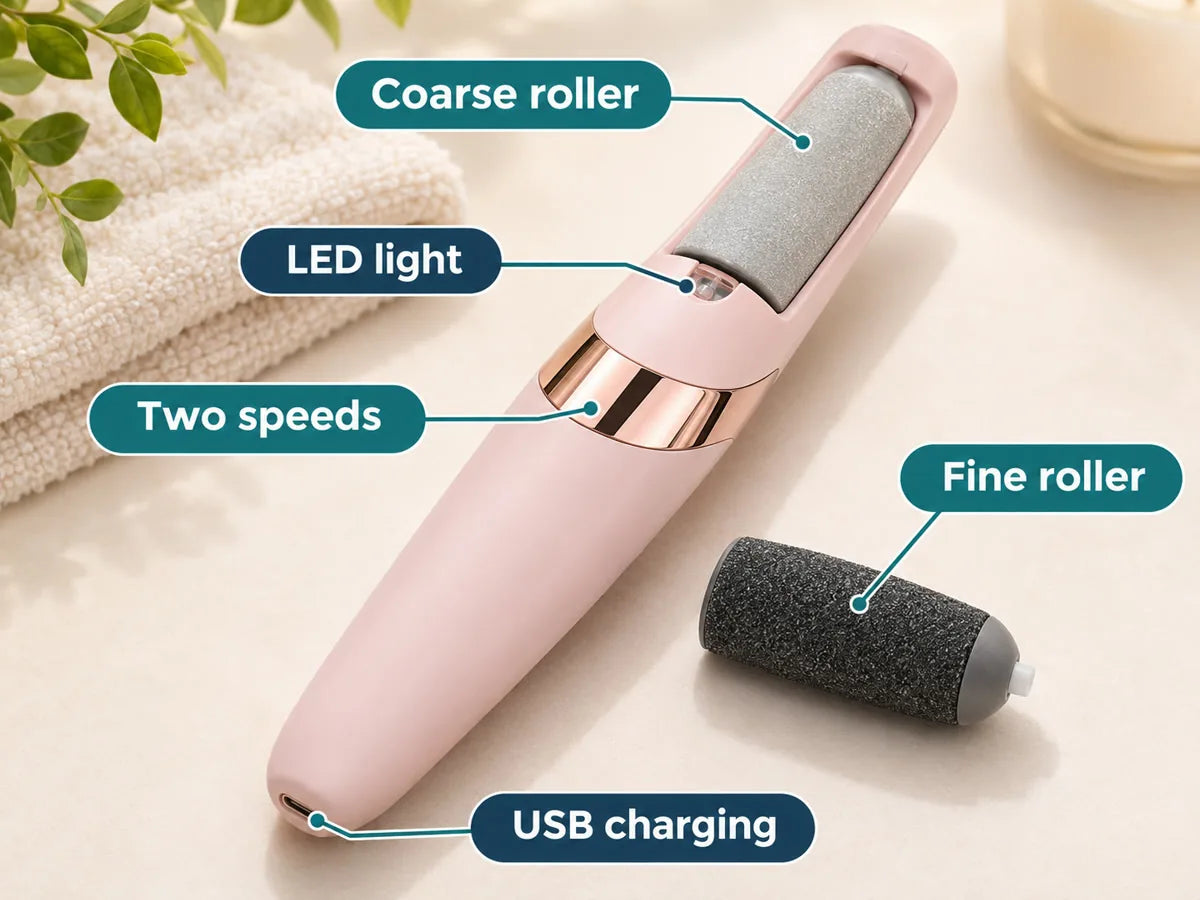
- Best for: rough heels, dry skin on feet and at-home pedicure upkeep.
- Time: about 2.5 hours to charge by USB for about 40 minutes of use.
- Pros: two roller grades, two speeds, washable rollers.
- Cons: shorter run time per charge than the other two files.
Electric Callus Remover for Feet with Spare Rollers
The Electric Callus Remover for Feet with Spare Rollers has a wide spinning roller that covers the heel in fewer strokes, which suits hard skin on heels and the balls of the feet. It runs at one speed, spare rollers come in the box, and the roller head pops off with one button for rinsing.
- Best for: hard skin on heels and at-home pedicures.
- Time: about 2 hours to charge for around 60 minutes of use.
- Pros: wide roller, spare rollers, quick-release head.
- Cons: one speed only and no full-charge light.
Note: Charge this file with a 5V USB source only and never use it while charging, and rinse just the roller because the body is not waterproof.
Cordless 2-in-1 Foot Callus Remover and Nail Buffer
The Cordless 2-in-1 Foot Callus Remover and Nail Buffer smooths calluses with sanding discs and buffs nails with small sanding sleeves. The head spins forward or in reverse, so you can work both sides of the heel without changing your grip, and a digital display shows the setting.
- Best for: rough heels plus nail buffing.
- Time: its 1,200 mAh battery (the battery's capacity) takes about 2 hours to charge by Type-C cable for around 60 minutes of use.
- Pros: two jobs in one tool, coarse and fine discs, reversible rotation.
- Cons: discs need replacing once they feel smooth, and the body must stay dry.
[dyl-products: rechargeable-electric-foot-file, electric-callus-remover-for-feet, cordless-foot-callus-remover-nail-buffer]
Frequently asked questions
How long should callus remover gel stay on?
It depends on the formula: up to 5 minutes for one kit and 10–15 minutes for one 12% salicylic acid gel. Never copy one gel's timing onto another. Follow your own label, then rinse thoroughly.
Can callus remover gel burn healthy skin?
Callus remover gel can irritate or burn healthy skin when it spreads beyond the callus or reaches a cut. Wear gloves if the label says so, and if your skin stings or turns red, rinse it off right away and stop using the gel.
What should you do after using callus remover gel?
After using callus remover gel, rinse well, pat your feet dry and file gently only if the label allows it. Finish with a moisturizer and skip filing on any sore spot. See a doctor if pain or redness lasts.
Callus remover gel works as a softener for thick callus on healthy skin, while an electric foot file smooths rough heels quickly without chemicals. If you use both, soften first and file gently, and check the safety limits first, especially with diabetes. Compare cordless files in our foot care devices collection, with free US shipping on every order. All three files above are sold by Decor Your Life with a 12-month limited warranty.